Friday, April 5, 2019
Day 1 - Nicobar Diaries
My Days in Nicobar
With the rosy idea of putting my daily jottings into a book some day, I scrap-booked and chronicled obsessively; now, I know that it will be several years (and more research) before that happens. In the meanwhile, I have decided to relive my time there by digitizing my memories here one day at a time.
Come tomorrow (and morrow and morrow and morrow), I'll have much to share.
Tuesday, March 26, 2019
Hullabaloos all around
At the end of our master's course together, you handed me a book by Kiran Desai called 'Hullabaloo in the Guava Orchard' with a characteristically-you, succinct, "Here's some sunshine for your life" note inside it. The cover intrigued me - a cartoon-y tree with the dangling legs of a person dropping into the frame from above. I didn't give it much thought when I started reading.
I began with no real expectations in mind - just the blind trust that you know me well enough to gift me a book I'd like regardless of its contents or genre. But then again, everything you do seems to stem from either purpose or reason, and I was secretly searching for either/or at the back of my mind as I progressed through the pages.
Kiran Desai's writing painted pictures of the mundane. She described sarees, food and the idle thoughts of a government employee with just the right number of adjectives and similes. She described each character in such delicious interwoven detail, that I was five chapters in with no clue about where the story was headed.
I took a break from the book for a while, shortly after Sampath, the head-in-the-clouds protagonist, let the characters of his reality into his mind for a quick peak, swiftly resulting in his routine life falling apart. This was also around the time I got sidetracked with work, travels and The Talking Ape. When I finished with that book, I got back to Sampath. Before I knew it, he was running further away from the life he had been thrown out of. He was literally running, with his dysfunctional family in close pursuit, up into a guava tree. The book's title began falling into place. While I was still skeptical about whether the bizarre events unfolding were happening in his head or in the book's real world of small-town Shahkot, I began relishing it.
I'm usually cynical when a book takes off on multiple tangential narratives as fillers for space and time, but this book did it brilliantly. It was so stuffed with characters and tales and little off-road, supporting stories, that I found it hard to stop reading once Sampath (and his paraphernalic-family) had set up shop in the guava orchard. I found it even harder to stop reading when the pages parted to make way for a notorious troop of monkeys, and irrevocably glued when the primates developed a taste for alcohol (there, I found my reasons*).
The book and its people danced in my head. You're teaching me to fall in love with good Indian writing - stories embedded deeply in intrinsically desi themes and characters. Having that added layer of relatability is exciting, and in a way, allows my imagination to create visuals with a lot more accuracy than if I were painting into place the extravagant lawns of Blandings Castle from a Wodehouse novel.
Never stop giving me your tried-and-tested book titles to read. So far, so very good.
Love always,
Ishika
*People I interviewed for my research work told me that monkeys would occasionally polish-off the left over bits of whiskey and rum in bottles from wine shops around Great Nicobar. The macaques would then either raid homes with a markedly lower sense of risk, or simply fall asleep. Upon hearing this, a certain Forest Department employee (only half jokingly) suggested we use alcohol as a mitigation measure against human-macaque conflict. Ah the colourful aspects of working with primates.
Thursday, January 24, 2019
Field-time Companionship/How I Learned To Read Again
Here are some of the books that stood out the most - they're now my trusty friends who have taken ship rides and tasted sea salt with me during my islandic isolation.
By Amitav Ghosh
By Glen Wright
By Helene Hanff
Since 2012, this book has been in the 'Always Reading' segment of this blog, and rightfully so. Helene Hanff is a kindred spirit. Her words jump at me from the pages of this book, grab me by the collar and shake their fist at me, angrily questioning why I wasn't alive when she was holed up in her tiny apartment, hunched over her typewriter, littering her beautiful words with cigarette ashes and lint from worn sweaters. In 84 Charring Cross Road, Helene (look at me calling her by her first name) has arranged the letters of her correspondence with the Marks and Co. antiquarian bookshop in London, situated on 84 Charring Cross. Her unfiltered American sarcasm bounced off of the polished British courtesies of her correspondents, largely a Mr. Frank Doel, makes for a page-turner. You can see their friendship blossoming into familial ties, despite never having met over decades of exchanges. This book, single-handed, reaffirms my faith in people every time it begins to wobble.
The Dutchess of Bloomsbury Street
By Helene Hanff
By Douglas Adams (and Mark Carwardine)
Reading a book like this one on field, after three semesters' worth of courses about wildlife conservation, can be very existential. Douglas Adams, who doesn't usually write about wildlife, tailed Mark Carwardine on his journey to seven rather remote locations, chasing the few individuals of some endangered species across the world. Quite literally, the duo undertook this series of adventures to areas like Madagascar, New Zealand and Zaire to look for species that were considered so very endangered, that it may have been their last chance to see them. Mark was an ecologist with the World Wildlife Fund, and Adams, a writer with a flair for humour, was assigned to accompany him by the BBC to help document his travels and raise awareness for these vanishing species.
Adams, being new to the trials of traveling to inaccessible regions for field work, found comedy in the logistical nightmares they faced. His narratives of the contrast between Mark's cool acceptance of the challenges of working with wild spaces, officials and scientists, and his own naivete towards them all, make for a fantastic read. Apart from the travelogue nature of this book, each chapter hits upon the ecology of each species, descriptions of the habitats they are found in and the threats they face. It's a wonderful mixture of the the seriousness of extinction, the vulnerability of certain ecosystems and the lighter side of the trials of conservation efforts. The BBC and WWF came together to choose the perfect man for the job, who could pinch your conscience and heart even through the smile he so firmly puts on your face.
By Harper Lee
In each chapter, he is unapologetic in his commitment to the possibility of our shared future turning out a certain way. I found myself constantly being caught up in philosophical viewpoints that opposed my own and I began disliking Harari for taking that contrasting stance. But then I'd be reminded that he was simply laying out multiple well-thought out hypothetical scenarios, and that he did not advocate any of them in particular. It makes me wonder what he actually thinks will happen. It's a good book to read as long as you aren't someone who worries needlessly anyway, because if you are, this could land many sleepless nights or sudden frozen moments where you stare into space (or the sea) and simply want to mutter, "but why?".
By Vivek Shanbhag
The story is so very Indian that I related to it even though nothing like it has ever happened to me. It's a tale of a lower-middle-class family that comes into a lot of wealth due to the enterprising decisions of an uncle. Beginning with the modest life they once led, sharing tiny rooms, old furniture and floor space with persistent ants, the family moved into a larger home with disposable income and, somehow, an altered sense of purpose and entitlement. A new bride joins this family in its post-wealth period, and becomes a moral compass and reference point that unravels the many layers of every character that Shanbhag has created. The ending of the book is chilling, and I found that to be the case because I saw a little bit of my own family in his characters. Without driving a literal point home, this book had my gut by the fist.
Saturday, November 17, 2018
Flight
I want to spread my arms along a sea shore and be lifted by the breeze, being thrown in every direction but my own. But I wonder if I'd handle that kind of total surrender with ease. After all these years of treading my own path and falling (mostly) consciously, I wonder if I could truly let my body go. I wonder if a hatchling that jumps to its first ever flight feels the same way a bungee jumper does before taking off. I imagine a young being, barely feathered, throwing itself into adulthood, and I'm baffled by the strength of instinct that makes them embody courage. And, after those first few awkward flaps, when the young bird takes to the sky for the first time, grace seeps into its feathers and stays there. When something as fluid and seamless as air supports them, how can their bodies be any different?
~ These are some scribbles from my bird-book, last maintained three years ago. I miss the pure, unfettered joy of birding ardently, and rediscovering these notes made me crave it again all the more. I leave these here as a thank you to Tarun, who's steadily bringing the birdsong back into my life.
Tuesday, September 18, 2018
Mansi - The Chirput.
I was working on field one annoyingly sunny afternoon, when my troop decided to scale two cliffs and make me work up an even heavier sweat. They were just settling down into a clump of Pandanus trees for an afternoon snack and siesta, when a family I had come to know ambled along. They were there to lop some wood in that secluded forest patch, and they brought their bumbling, black-and-white dog along to keep watch. The dog, however, promptly hurtled towards the snoozing macaques, wagging his tail eagerly in hope to play. The macaques found in him a play thing rather than a playmate, slapping his snout and then jumping just out of his reach.
While the husband and son dodged the monkeys and got down to their business, the wife hid behind me, worried that the large male near my feet would jump up and swipe her. While she hid, she asked me if I had seen the Forest Department's "new baby monkey". She wasn't the first one to mention its existence, and I was beginning to take this rumour seriously. There was an air of secret celebration, as though the fertile Department had borne an infant to the island.
Before I knew it, I was brought face-to-face with this fragile, wrinkled, scrawny thing. She looked alone and crinkled in her makeshift cage. While I held onto the still-solid portions of my melting heart, I scooter-ed off to the marketplace where I found some milk powder, overripe bananas and a mother-macaque-sized soft toy. I whizzed back to the piddly one with these items to find her clutching the cane that formed the mesh of her cage. Her wet, brown eyes looked up at me with piercing longing, melting all that was left of my cardiac muscles.
I opened the door and offered her my arm, which she took with all four of hers and held onto with resolve. I could feel the thirst for contact in her grip, which seemed only to tighten with time and trust. She swung from my clothes, body and hair - never losing hold of me. I was starting to understand directly how these infants cling onto their mothers as they leap between trees and rooftops. With fingers and wrinkles which provide arboreal certainty across media, any movement was possible, no matter how petite. I remembered the way my sister wrapped her hand around my finger as a baby, and couldn't help wonder about how unimpressive human babies are when compared to our evolutionary sisters.
She clung for three hours - initially playing and eventually falling asleep. She climbed her way up into the inside of my shirt collar and slept in the warmth of my neck. I cupped her thin body with my palm, enveloping her entirely, as I felt her chest heave against me. She hugged my neck with her delicate, long, pink fingers. Her skin felt as soft as a newborn's, but had the texture of someone much older.
I felt a fierce protectiveness towards Mansi instantly. Spending that time with her felt more profound than I thought it would be. This young macaque had lost her mother, and somehow found her way into the human realm. Not so different, albeit larger, I found how I was a plushy candidate for the role of 'mom', and wanted nothing but to give her the best care within my control. If I was there only for another few months, I was going to try to do what was best by her.
When I peeled Mansi away and returned her to the enclosure, I felt cold and bare where she had been resting. I left her that night hoping ardently that she survives to an age where a troop would accept her. In the following days, we grew increasingly fond of each other, and I watched with hope and pride as she grew more dexterous and agile. I selfishly rejoiced on the inside when she preferred my arms to others, but always felt the bitterness of having to leave her island home soon.
Now, nearly 2000 kilometers away from her, with only sporadic updates about her health, I miss her ardently. Regardless of whether I see her again, the intensity in her eyes, the softness of her fur and the smell of her pee will forever remain etched in my mind.
Mansi, you lanky bit of jet-black hair, I hope you keep hanging on.
Thursday, May 10, 2018
Ek chai toh peekar jao
Then, in 2004, a tsunami hit, washing out decades of hard work and development, not to mention hundreds of lives and homes. Ever since, the survivors have crawled back to a semblance of what once was, aided by Government subsidies and rations. Today, the previously spread-out habitation has shifted to a clumped distribution of nine villages along a new road – running along the coast and through forested hills for 35 kilometres.
When I came to the island to study human-macaque interactions, I had planned to divide my work into behavioural observations of the monkeys, and one-on-one interviews with the local communities to better understand their take on the issue, their experiences and collective histories. For the past six months, I’ve been regaled with tales of the monkeys I’ve grown so fond of. Simultaneously, though, I’ve been caught in an endlessly looped battle of wits – that of the peoples’ plight and the macaques’ actions. Picking a side can never be part of a scenario like the one present here – my heart wishes to be parted like my methodology, lending complete sympathy to both the people and the macaques.
Despite this, a new itch has been occupying my mind off-late, one of metropolitan disgust and guilt.
Having grown up in a place like Mumbai, where trust is scarce and home exists behind two closed doors bolted tight, places like the Andaman and Nicobar Islands seem like a confusing paradox of society at first glance. Here people enjoy company, the notion of having visitors arriving unannounced, making tea for a crowd, sharing meals and lives. Here, time is a gift that’s meant to be shared, not a constraint within which life seems fleeting. People from the metros shy away from interaction; we shield ourselves behind the illusion that sparing a moment to hear someone out will eat into our minimal allotment of cosmic time. Where did this manic selfishness arise? Or rather, when? Perhaps our fear of the unknown is further exacerbated by our unwillingness to learn more about the people around us. In a society where people are more numerous than our cranial capacity to retain, and where everyone is a stranger living by an unwritten code of order amuck observable chaos, could one open their arms wide and share tea, food and time? Even the eternal optimist within me leans towards a resounding, ‘‘no’’.
I’ve been to nearly 200 homes here in Great Nicobar. Most of these homes are left ajar, often with a flimsy curtain hanging by the doorframe. The shuffle of my feet and some stirring barks from nearby dogs attract the residents’ attention. Immediately a chair is produced, chai is placed over the stove and conversation is struck – all before knowing who I am or where I’ve come from. I was worried about being an intruder, an inconvenient blotch on their routine days. This anxiety didn’t last long, though. I soon found that wondering if a family would rather I didn’t visit is an insult to their culture of hospitality. Rejecting an invite to come in, have some nimbu paani or chai, or to stay for lunch is an offence akin to outright rudeness. I began to relax, welcome the hospitality, home-cooked meals and willing company with open arms, and it transformed the way in which the locals perceived me too. I became one of them, one who held onto no pretence or inhibition, and who partook of their characteristic islandic gossip. I have the families here to thank for my own personal growth – these lessons and realizations can’t be shaken irrespective of where I go from here.
When people who have so little, who’ve lost so much, can give so voluntarily without batting an eyelid, what is it if not arrogance that makes the privileged so stingy with their time, courtesy, respect and love? Sure, I may not welcome strangers into my home without a care in the world from here on out. But I know my conscience will sting deep if I fail to extend at least a shred of the decency that has been showered upon me through my travels.
Saturday, March 31, 2018
Trust
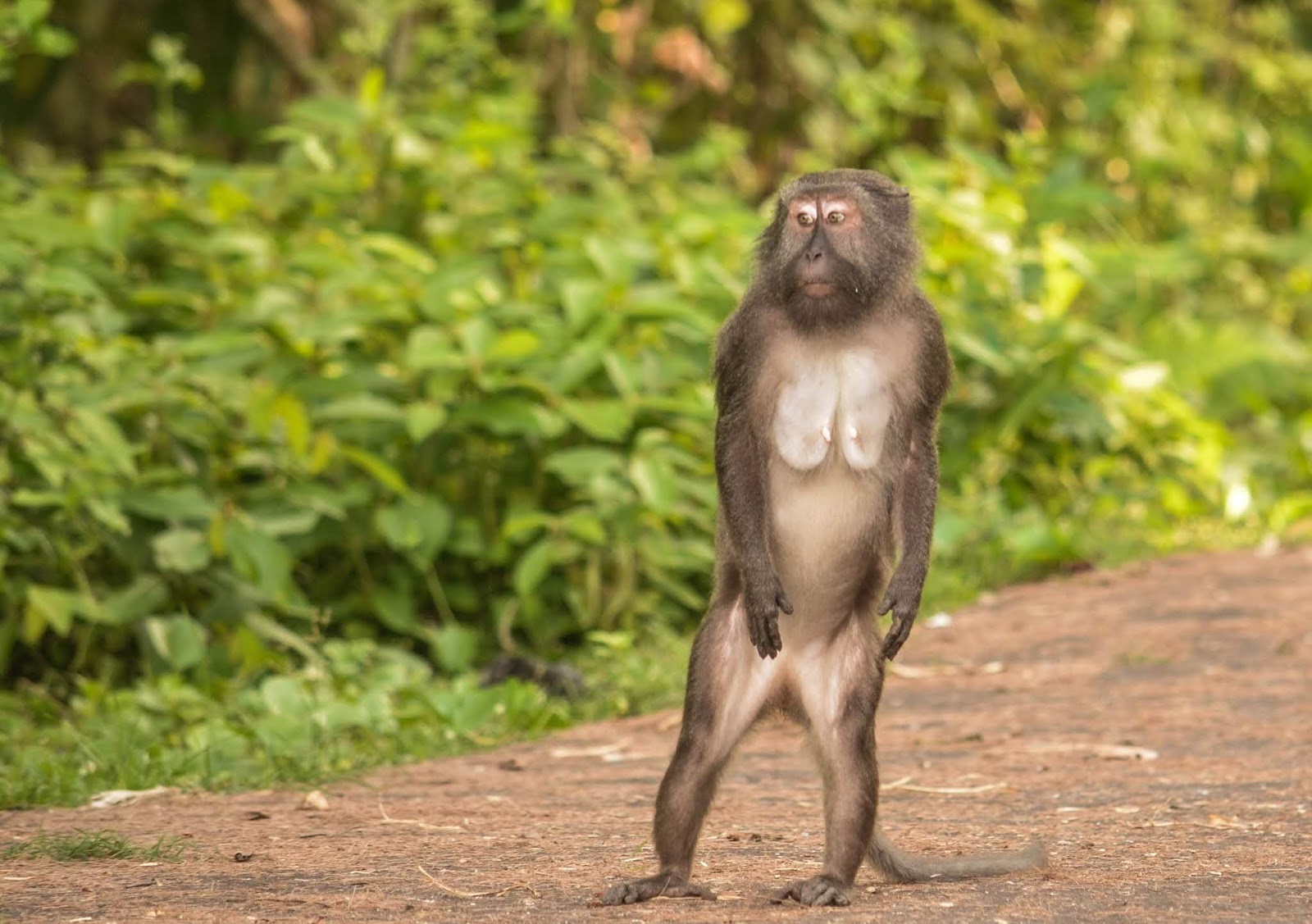
It’s been five months since I arrived on the island of Great Nicobar. I’m here to collect data for my Master’s thesis, which is focused around the Nicobar long-tailed macaque and its interactions with people. Much like the macaques in Southeast Asia, these guys have been creating steady havoc by raiding coconut plantations and vegetable gardens all over the island, and I decided to study their behaviour and the locals’ perceptions of the issue at hand. This is one of the three Nicobar Islands housing the rotund, grey, furry monkeys that have created a reputation for being intelligent, sneaky, dangerous and annoyingly prolific. Most people still stare at me in disbelief when they learn that I travelled ‘all the way from Bangalore’ to study what seem like every day, common pests.
These monkeys have faces that seem astonishingly readable at first glance. Unlike some of the other macaque species, they have long hair on their faces, but none around their eyes. Their eyelids are several shades lighter than the rest of their skin and body, and they stand out distinctly under their thick, bushy eyebrows. Their eyes tend to be a caramel brown – piercing when directed at you. When I first began following them, I was the one being observed. It took a month of respectful distance and nonchalance on my part for the troop to relax in my presence. During this period of habituation, I began to notice personalities and tendencies of several individuals and discover their responses to my body language. I took notice of them taking notice of other passers-by, but not of me. I realized at this point that they either trusted or tolerated me, and I was keen to know which one it was.
Initially, I found that I couldn’t sit down during the day. Every time I did, I suddenly became accessible; a curio that the larger males and enthusiastic sub-adults would make a beeline for, probably hoping to raid me for some food. They’d be abruptly aware of me, as though I appeared out of nowhere, and this bothered some of the more timid and cautious individuals in the group. Just as you’d find in a social gathering of people, within the troop, some monkeys take longer to warm up to you than the others, some are ever-suspicious, some are eager and inquisitive, and some simply don’t care. Soon, I found that majority of the troop fell into the last category. Having moved from an unwanted intruder that prompted an angry chorus of alarm calls through the forest patches to one of unexciting, repetitive and uninteresting demeanour, it felt like an achievement. Never before had I been as happy to be the one not worth noticing.
This being said, I’ve come to share some tickling moments in close proximity with those whose lack of concern for me led them to attempt interaction. On one such day, I sat down in the grass, tired from having walked after them for nearly eight hours. I put my clipboard in my bag and watched the monkeys groom themselves lazily in the cloudy afternoon haze. I suddenly felt one of the monkeys grip my shoulder. It was Tripod, one of the more dominant males of the group. Having made contact with me uneventfully, three other sub-adult males, a female and another adult male made their way up to me. From their casual strides and relaxed eyebrows, I felt rather confident that they meant no harm. They seated themselves around me; a couple leaned against me and began to doze off. My heart was thumping against my chest and I could feel the pulse in my neck – I was elated. Just then, their little hands began touching my arms and legs. They lifted my shirt sleeves to inspect underneath. They began to pick ants off of my pants and pop them into their mouth. Tara, another male, used his teeth ever so gently to pull off some scabs on my arm. I was being groomed. This lasted no longer than five minutes, before a female some feet away seemed to disapprove of the gathering. She raised her eyebrows rapidly, sounding low alarm calls while shooting glances at several individuals around me. I rose and stood back slowly, and the female went back to grooming her infant, as though the whole thing never happened.
On another day, I was standing fairly close to the troop while noting down some data, when a huge fight broke out among the monkeys. Nearly every adult ran frantically to the centre of conflict and the air filled with their calls of skirmish. I was left standing amidst those who opted out, now some distance away from most of the troop. As the ruckus died down, the adults slowly sauntered back to where I was. There was palpable tension in the air that I couldn’t shake; it seemed like they couldn’t either. Several monkeys searched me with their eyes as they passed by, something that was rather unusual. A couple of them sent rapid signals to the others, and several began grunting at me. The males pulled themselves up to their full, impressive height and advanced towards me in an unamicable fashion. A couple yanked at my pants and bared their teeth. Once more, I silently backed away, and they settled down almost instantly.
I realize now that even if what they have toward me is tolerance, they trust me to understand their signals. In both the occasions I related (and some more which I didn’t), the monkeys could have easily torn me to shreds with their remarkable canines and hardy nails; they have with others in the past. They could have chased me far away from where they rested; again, they have with others in the past. Instead, they chose to provide me with a minimalistic warning and let me off easy. Maybe they were okay with having a human amidst them who hadn’t tried to harm them thus far, unlike nearly every other person they encounter each day. Whatever the reason, these events help me stay grounded and remember never to take their acceptance for granted. I have utmost awe and respect for these animals, no matter how amusing, strange and quirky they can be at times.
These fantastic, wild creatures are complicated. They have moods, personalities and emotions; and I don’t feel presumptuous for saying it anymore. Watching them day in and day out for these past few months only convinces me of this further. Perhaps the data I collect will fail to portray this, with only numbers telling tales of their behaviour, but the experiences I’ve had with them will remain more fascinating and dear to me than can be statistically discernible.