Tuesday, April 9, 2019

Day 5 - Nicobar Diaries

Today was an uneventful day. Akshay and I went around town running some errands. We printed out some data sheets, permit letters and then checked a few more places for a reasonably-priced second hand scooter. After looking at the garages and showrooms we knew of and coming up blank, we went to Switz for some tea (They have surprisingly tasty milk tea, even though they never advertise it. The tea simply appears from their closed kitchen door if you ask for some).

While paying up, Akshay took a chance and asked the cashier if he knew anyone who was looking to sell their scooter and JACKPOT. He wanted to sell his own. A black Activa of the H-series, four years old. I love how accessible people can be when you're in the islands. The inhibition to approach someone new and talk about anything drops several fold.

He wanted 25 thousand for it. We exchanged numbers and I test-drove it in the evening before heading back to ANET. It rode really well. It didn't have mirrors, but that's one of the easier and cheaper things to get fixed anyway. I asked him, Naushad, to consider giving it to me for 20 k and we left each other to mull over the offers. My project funding hadn't kicked in yet anyway, so I was in no hurry to part with money.

Akshay and I got a lot of inescapable time together today - bus rides, rickshaws, tea kadais and wifi cafes. It was nice - like a reassurance of what I already knew was a good friendship with the potential to last. Too bad we're going to be working at the two extremes of the islands.

Day 4 - Nicobar Diaries

12th November 2017, Chidiyatapu

Woke up early this morning to head to Chidiyatapu. It's about 1.5 hrs away from ANET with a bus change halfway through.

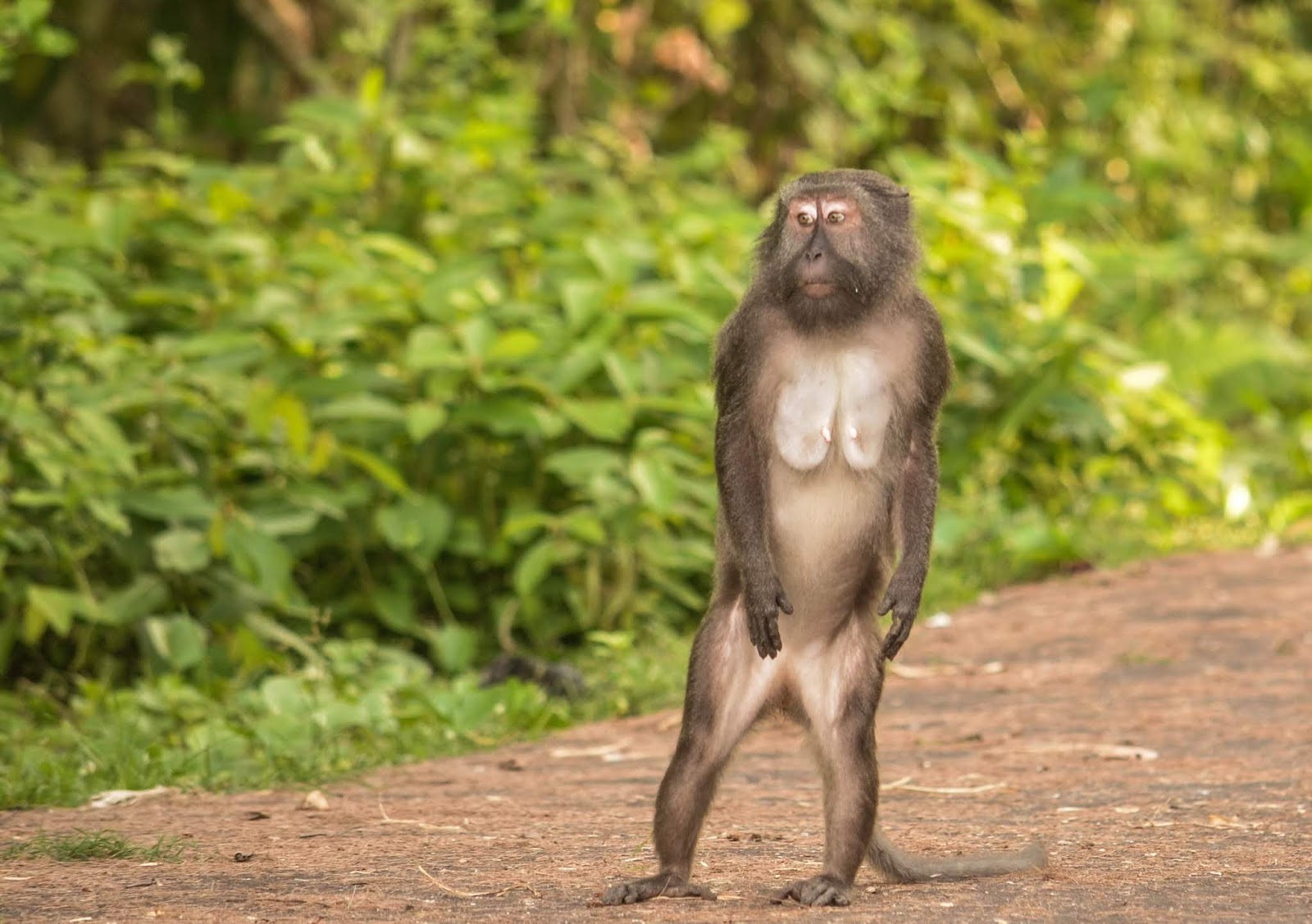
There's a biological park there with a handful of well-maintained enclosures for reptiles and mammals, along with a campus full of labeled large trees. It's a peaceful place to look at plants, work on tree-identification and simply go birding. I came to love the place, especially in the mornings before tourists came by, during my stay in the monsoon. I was stuck in Port Blair for 10 days longer than I intended to be back then (thanks to the fast-filling ship seats). I used that time to interview fishermen early in the morning and then watch the captive macaques at the Chidiyatapu Biological Park until it closed. I'd take the early bus towards the park, often with rain trickling into my useless raincoat through cracks in the bus, and get there in time for a cup of tea and samosa before it opened for the day. I came to know the Keeper fairly well in that time, and he would tell me colourful stories about the macaques' exploits (since I was his only available audience). I maintained a tiny notebook of what the monkeys did during the day, often dozing off in the afternoon along with them. They would roll their rotund, overfed selves into the shed in their otherwise open-aired enclosure and snooze in a primate bundle. I would sit on the tiny bench under the tiny roof opposite their enclosure, drenched from the rain, falling asleep over my soaking binoculars.

Although I was up and ready to head out early to the park like I used to, Akshay, Dayani and I soon realized that the rush of the Andaman Avian Bird Club (wonder why the felt the need for 'Avian' and 'Bird' in their name) would still be there till 10 am, owing to it being Salim Ali's birthday. We figured that it made little sense to set out that early and skip breakfast. Then, we noticed that Johnson* was making roti and chole, so that sealed the deal.

While walking down to the ghumai** later, we birded. We saw a juvenile crested hawk eagle and a HUGE flock of white-rumped munias. I've never seen so many together and up-close. They were mini-murmurating between the telephone wires and a rice field. Their calls seem like they're coming from way beyond - a gentle chatter lost in the breeze.


We got to Bathu Basti (en-route to Chidiya) only to realize that the next bus to Chidiyatapu was 1.5 hrs later. We killed time and money at Switz and ultimately took a rickshaw for lack of patience. The drive was lovely, as always. The blue of the sea had returned up to the shore post the monsoons (although it's still the season for occasional downpours).

Since we hadn't done lunch yet, we bought some samosas for later from the Aunty next to Cafe Infinity. She recognized me and asked where I'd been this whole time, leading to a small conversation in Tamil. It's always nice to be remembered by someone you remember well.

For the first time since my visit with Tarun, I did a whole round of the place with Dayani - I used to head straight to the monkeys ever since. It took us about half an hour to reach the monkey enclosure this time. I felt immediate relief and affection - a combination of emotions I reserve for seeing Chaplin*** healthy and well after a long time. The two juveniles were much larger than I last saw them. They were still in the maximum-time-spent-clinging-to-mom phase in June. Now, they were flinging themselves between branches without a care in the world. I had two long hours of solo observation with them before Akshay and Dayani joined me after looking at all the trees in the park.

Things I saw:
1. They flush insects out of the grass. They almost catwalk through the grass, parting the blades in their path with every step.


2. They catch flying insects from the air and eat them - like it's muscle memory.
3. The older female that seemed to be cast aside the first few times I was here still seems to be less socially involved in the group. Although there were no acts of aggression towards her, she kept to herself.
4. Lott, the Keeper I befriended the first time around, definitely had it wrong. He would insist that the zoo had four females co-existing in that enclosure and that their only male was kept separately at the back since he was too charged-up with testosterone. We would argue about this even then. Today, I observed how grooming led to the display of very red bottoms, which further led to the mounting and mating by the largest individual of the group - a male. Apart from the final mounting, I managed to record all the steps leading up to it - just in case I saw Lott and could do a victory lap.


People have ALL kinds of opinions about these monkeys. In the two hours that I sat there, many visitors came by, leaving me privy to their conversations. I was highly amused by their chatter -

"They are all kala bandar****. We should stay away."

"They are gorillas."

"They are from South Africa." (Confidently mentioned by boyfriend to girlfriend while standing over an information board that read 'Nicobar crab-eating macaque'.)

"They are pyaara and ittu-cute*****."

"They are very dangerous!"
An islander who was with his family recounted a story of how these monkeys severely mauled the face of a new Keeper about a year ago when he came in to feed them. His daughter, excited that his father struck up conversation with me, asked me for my binoculars and went closer to use them. Even though transition and habituation are important for species like these, I wonder how much truth is in these stories.

We emerged when it was getting dark, and another chai later, realized that the last bus back into town was bursting at its seams. We chanced upon Ravi - our trusty and resourceful cabbie who takes great pride in ferrying researchers around - who gave us a lift back to Bathu Basti. On the way, we found a molting Andaman pit viper crossing the road. We screeched to a halt and got to watch it painstakingly cross over to safety. A wonderful end to a long day.


_____________________

*Johnson is one of the ANET boys who helps Sanjay cook and take care of our hunger-related grievances.
**Ghumai translates to a roundabout - it's about 1 km away from ANET where we catch buses to go into town.
***Chaplin was my ageing dog back in Bombay who I'd miss on all my travels. I used to have nightmares about waking up one morning and hearing that he was unwell or, God forbid, no more.
****Translates to 'black monkey' which is used in a derogatory sense very often.
*****lovable and tiny-cute!

Monday, April 8, 2019

Day 3 - Nicobar Diaries

11th November 2017, ANET

Got an early start this morning and went birding with Akshay, Madhuri, Mahima and a Vice Chancellor of a university on the mainland (I forget which one). This sweet and polished man had arrived at ANET last night with his wife. He was so intrigued by our visiting Andaman scops owl by the dinner table and all the chatter about the birds you see in and around campus that went along with it, that we enthusiastically volunteered to take him birding for the single day he was there for. At night, we took a walk down the road outside under the cloudless, starry sky looking for any snakes and/or owls. We were rewarded with an Hume's hawk owl (whose call we followed until sighted) and, sadly, snake roadkill. It was wonderful to see how excited this little man was to see the owl sitting in a tree, blinking into the street light. He tilted his golf cap to one side and tried to get a good photo of it, but then handed his camera to me to do the same - just in case his hadn’t turned out well enough.

After breakfast this morning, I noticed that I had an email about my human ethics application*. I finally had a format to work with, so I spent the rest of my day making sure all of it was in place. I was glad to finally be doing this systematically, after having taken a moral standpoint (in my head) about how unethical some other studies I had read about were. I was quite excited about all of the ethnographic work I was going to do, and writing out the application gave me the chance to really get into the details of what I had planned. I spent two hours being sidetracked reading papers and anthropological methods that looked at issues qualitatively. I also got my datasheets and ethogram** in place. I impressed myself with the outburst of productivity - but I know it was mostly a distraction from the fact that it was already the second week of November and I wasn't in Nicobar yet.

The ANET library

I then took a breather, had an icy bath (after much personal motivation) and decided to watch Baby Driver, since Chandy had been nagging me to for months. The smell of brewing chai dragged me out of the library and its falling geckos. The chai had drawn more than just me, so the rest of the evening transpired through multiple conversations about local fishing practices, the Nicobarese communities, social science, owls and local dogs. As tends to happen around a table (that converts into a makeshift table-tennis top) with fun and seasoned island researchers, I can barely remember how these topics came up.

Here’s a list of the birds we saw this morning:
Brown shrike (~3)
Andaman coucal (2)
Common mynah (many)
White-breasted waterhen (3)
Red collared dove (5)
White-headed starling (many)
Blue-eared kingfisher (for the first time! The blue is so vivid, even when the sun isn’t shining directly over it, that it looked unnatural. Like an image taken by a Photoshop enthusiast with the saturation taken up all the way.)
Plume-toed/glossy swiftlet (many)
Long-tailed parakeet (2)
Small minivet (5)
Black-naped oriole (2)
Greater racket-tailed drongo (3)
Olive-backed sunbird (3)
Red-whiskered bulbul (4) (these guys were never meant to be on the island - they were introduced and have now set up shop with resolve.)
Chestnut-headed bee eater (4)
Oriental white eye
Black-naped monarch (being chased by the white eye)
Vernal hanging parrot (3) (with a bright green Phelsuma/Andaman day gecko lying along the trunk of the same tree)
Oriental magpie robin
Collared kingfisher
Green imperial pigeon (3)
Andaman flowerpecker (I love how the islands have but a few species with ‘Andaman’ or ‘Nicobar’ before the bird group - makes them so easy-lazy to identify.)
White-throated kingfisher (2)
Crested serpent eagle (a long, clear and close sighting, just by the beach. Saw it catch and eat what I think was a lizard.)
Asian koel (female)
Common/Eurasian moorhen
Andaman drongo (2)
Wimbrel

______________________

*Since I planned to do social surveys and talk to people from multiple communities about their lives with monkeys, I had to get a human ethics clearance before I could begin. After sending in my proposal twice and sending a bunch of emails, I finally discovered what was expected of me that^ day.
**An ethogram is a list of behaviours - along with their detailed, literal descriptions - that an animal could potential engage in. I had created one in advance for the Nicobar long-tailed macaques that I was about to study based off of what I had observed them doing during my recce visit in the monsoon.

Saturday, April 6, 2019

Day 2 - Nicobar Diaries

10th November 2017, ANET

Another long day outside.

I went birding early this morning with another researcher here. The road just outside ANET is narrow and largely quiet - there are a couple of farms and woody patches to one side and the ANET littoral property on the other. The simplest birding route is winding, leading straight up to beach. The last time I was at that beach during my recce visit in the monsoon, I was wading ankle-deep in sandy muck. This time the ground was firm and dry. We saw coucals, white-headed starlings, green imperial pigeons, lots of chestnut-headed bee eaters and a single collared kingfisher.

Akshay and I went to Wimberly Gunj [Wandoor to Goal Ghar by bus > Goal Ghar to Chatam Jetty > A ferry across the jetty to Bamboo Flat > A share-gypsy to Wimberly]. Aforementioned researcher called it Waverly Gunj and I can’t stop saying that in my head. Today we got a lucky lift all the way to Goal Ghar from Wandoor - very welcome since we missed the last Subhashini and we’d have had to wait for another half hour for the next one. The ferry to B-Flat (as it is very coolly referred to) was breezy and sunny, with terns flying by us. I could see the silvery-green fish skirting the rusty edges as we broooooomed along. It was nice to be back here for work after the joy ride to Mt. Herriot in April’17 with Tarun.

We got to the Forest Department to meet a Mr. Tilak who seemed perfectly nice and soft-spoken. I simply tagged along since I didn’t have anywhere specific to be. I made some logistics-related phone calls along the way. My accommodation, local transport and field assistant situation in Great Nic still seemed vague and far from in-place even after making half a dozen calls. Either way, I was heading over there soon enough and that was all I needed to keep me going for the moment.

We came back via Haddo (where the FD is), so I could fax my arrival and project details to the Deputy Forest Officer in Campbell Bay. When I spoke to A* about needing to buy a scooter here before heading to Nicobar, she promptly sat me in her swanky Govt of India car to scout the garages that her ‘man’ had contacts with. Sadly, no luck. Worked for a while from the Department and then left.

Akshay and I went to Milky Way, an ice cream place in Haddo that promises half hour of free internet. Unfortunately, the free internet was just 2% of a wifi bar. We soon headed back. Stopped at a Garacharma** tea kadai*** for a nice, stiff cup of chai and day-dreaming of the months to come before pushing ourselves into one of the last (crowded) Subhashinis headed homeward.
___________________________

*From yesterday’s post
**A midpoint bus stop on the way to Wandoor - essentially a strip of road that has a few tea stalls, mechanics and 3 privately run buses competing for commuters at any given point.
***A Tamil word for tiny corner shops

Friday, April 5, 2019

Day 1 - Nicobar Diaries

9th November 2017, Andaman and Nicobar Environment Team (ANET) field base, Wandoor

We got here late last evening, just in time to kick start the field season with all the ANET veterans and Sanjay's* food - cooked in his characteristic there's-a-party-tonight haste. 

With a lot on my mind, I hardly got any sleep last night. I completely awoke with the sun at around 5 am, listening to the Andaman shama's oddly husky song. I was ready to go to the Forest Department and plead for work permits way before I needed to be. Akshay** was still asleep, recuperating from the previous night. I was sitting outside the ANET hall waiting until it was time to leave when I saw four young skinks that seemed to have just hatched. I watched the tiny, skinny, glossy fellows until they all dispersed. Even at that early stage, it seemed like they had their own personalities. Two scurried away in a terrible hurry, one was ever-cautious (finally choosing to take shelter under the stone slab he emerged from) and one basked openly and began foraging. I must have been watching them for nearly an hour.

We stopped at Delanipur for breakfast (hello again, Kerala parotta) and some scooter inquiries which got me nowhere***. We then went to A's office in the Van Sadan building - I was meeting her for the first time. She was dressed in a crisp, well-ironed, classy-coloured saree; she got up and shook my hand. She immediately seemed like a person who is both well-aware of her power and careful about how she uses it.

Together, we drafted a letter to B, requesting the provision of permits without my proposal going through the Research Advisory Committee. It was utterly useless, though. He was a large-headed, spectacled wall off of which my pleas bounced back and smacked me in the face. He asked me to meet C instead.

Although C looked like an intimidating diamond merchant who was cheesed off with the world, he seemed to be the only person from the Forest Department who had the clarity of thought to know how and when to break through the bureaucracy. He sat back in his large, black chair, rubbing his eyes as though in exasperation, while he told me things like****:
1. You have to tell these department people to keep their ideas to themselves. When their work load is light, they end up harassing people like you with unnecessary meetings.
2. Are you mad? Who asked you to submit a proposal to begin with? You've got yourself into this mess. You don't even need permits.
3. Damned people, all sitting around like they're unemployed. No one does any real work, they just spread tension.
4. (When A mentioned that I was worried sick about not getting permits) Oh no, then why did I tell her to go ahead? I could have kept her in tension for another 10 days (followed by hysterical laughter).
5. You just want to stand on the road and look at monkeys like a tourist would, right? So go! Quietly head to Great Nicobar and don't hand in any more papers.

 He didn't even look at my paperwork. I couldn't tell whether to be relieved or worried further about the unofficial shadiness. But then again, it isn't unofficial or illegal since I don't really need a permit. I decided to stay relieved. I called the Deputy Forest Officer in Campbell Bay (Great Nicobar Division) and informed him of the situation. It was all good (?).

Somehow, I had the go-ahead I needed on the FIRST DAY. My schedule suddenly moved up a couple of weeks and I had nothing but logistics to figure out.

On the way back to ANET, I stopped by Switz Bakerz for a celebratory piece of cake. The moment I squeezed onto the Subhashini bus, heard the familiar playlist of obscure Bollywood songs and shared a nod of recognition with the conductor, everything began to sink in and feel normal. Plus, I had Sanjay's cooking to look forward to at the end of it all. 

Took a walk up to the beach with Akshay before turning in at night. On the way back, I looked up at the sky and remembered my walk along the same path on the last night of our marine biology course in the islands. That night, I had welled up immensely, wondering if I'd ever have the opportunity to come back to this place which felt so strangely like home. I felt silly in that moment for ever worrying.
_______________________________

* Sanjay is one of the ANET field staff - a brilliant cook with low tolerance for dilly-dallying, an obscure sense of humour, fantastic taste in dance music and the latest "in" hairstyle.
** Akshay is my former batch mate, dear friend and tree-ID whiz. We envisioned our master's projects in the Andaman and Nicobar Islands and got to travel together and meet intermittently because of it. He's beautiful.
*** I needed to buy a scooter in Port Blair so I could put it on a ship and transport it to Great Nicobar where I'd be doing my field work.
**** All of this was in Hindi in my diary, translated here for better understand-ability. It has, in the process, lost some magic.

My Days in Nicobar

It's now been almost a year since I got back to Bangalore from Great Nicobar and I miss it as much as I did on my first day away. I was flipping through the pages of my bursting-at-its-seams field diary, feeling nostalgic and emotional, when I felt incredibly stupid. I was holding a bundle of special moments, natural history and oddities of the island's humanity, and in that moment all of it felt moot.


With the rosy idea of putting my daily jottings into a book some day, I scrap-booked and chronicled obsessively; now, I know that it will be several years (and more research) before that happens. In the meanwhile, I have decided to relive my time there by digitizing my memories here one day at a time.

Come tomorrow (and morrow and morrow and morrow), I'll have much to share.


(^She's *looking out* for upcoming posts)

Tuesday, March 26, 2019

Hullabaloos all around

Dear Akshay,

At the end of our master's course together, you handed me a book by Kiran Desai called 'Hullabaloo in the Guava Orchard' with a characteristically-you, succinct, "Here's some sunshine for your life" note inside it. The cover intrigued me - a cartoon-y tree with the dangling legs of a person dropping into the frame from above. I didn't give it much thought when I started reading.

I began with no real expectations in mind - just the blind trust that you know me well enough to gift me a book I'd like regardless of its contents or genre. But then again, everything you do seems to stem from either purpose or reason, and I was secretly searching for either/or at the back of my mind as I progressed through the pages.

Kiran Desai's writing painted pictures of the mundane. She described sarees, food and the idle thoughts of a government employee with just the right number of adjectives and similes. She described each character in such delicious interwoven detail, that I was five chapters in with no clue about where the story was headed.

I took a break from the book for a while, shortly after Sampath, the head-in-the-clouds protagonist, let the characters of his reality into his mind for a quick peak, swiftly resulting in his routine life falling apart. This was also around the time I got sidetracked with work, travels and The Talking Ape. When I finished with that book, I got back to Sampath. Before I knew it, he was running further away from the life he had been thrown out of. He was literally running, with his dysfunctional family in close pursuit, up into a guava tree. The book's title began falling into place. While I was still skeptical about whether the bizarre events unfolding were happening in his head or in the book's real world of small-town Shahkot, I began relishing it.

I'm usually cynical when a book takes off on multiple tangential narratives as fillers for space and time, but this book did it brilliantly. It was so stuffed with characters and tales and little off-road, supporting stories, that I found it hard to stop reading once Sampath (and his paraphernalic-family) had set up shop in the guava orchard. I found it even harder to stop reading when the pages parted to make way for a notorious troop of monkeys, and irrevocably glued when the primates developed a taste for alcohol (there, I found my reasons*).

The book and its people danced in my head. You're teaching me to fall in love with good Indian writing - stories embedded deeply in intrinsically desi themes and characters. Having that added layer of relatability is exciting, and in a way, allows my imagination to create visuals with a lot more accuracy than if I were painting into place the extravagant lawns of Blandings Castle from a Wodehouse novel.

Never stop giving me your tried-and-tested book titles to read. So far, so very good.

Love always,
Ishika


*People I interviewed for my research work told me that monkeys would occasionally polish-off the left over bits of whiskey and rum in bottles from wine shops around Great Nicobar. The macaques would then either raid homes with a markedly lower sense of risk, or simply fall asleep. Upon hearing this, a certain Forest Department employee (only half jokingly) suggested we use alcohol as a mitigation measure against human-macaque conflict. Ah the colourful aspects of working with primates. 

Thursday, January 24, 2019

Field-time Companionship/How I Learned To Read Again

After nearly three years of (a) taking inordinate amounts of time to finish small-ish books, (b) starting books and not finishing them, and (c) hoarding up on newer, more interesting books nonetheless, I optimistically packed four books into my rucksack. I was headed out for about seven months of seclusion on the island of Great Nicobar, and four seemed overly-ambitions with my proximate track record. Boy, was I wrong.

I ended up reading around fifteen books, not including a couple of poetry compilations that kept me going on most days (living alone allowed me to strut about reciting loudly from Sarah Kay or Walt Whitman's collections. My heart was alive, as I professed poetically while cooking every night). It turns out, long ship rides aboard the M.V. Campbell Bay, sea breeze, complete solitude at my field base and the lack of internet facilitated my every loner hobby, reading included. 

Here are some of the books that stood out the most - they're now my trusty friends who have taken ship rides and tasted sea salt with me during my islandic isolation. 

The Hungry Tide
By Amitav Ghosh


This was my reintroduction into the world of fiction after a two-year sabbatical from it, and I couldn't have asked for a better one. I spent most of my first ship ride to the island sitting in the blistering sun on deck, reading my hardbound copy of The Hungry Tide. I mention hardbound, since it proved to hold up well against the fairly-frequent sea sprays that reached it. 

This book charts the story of an NRI cetologist, Piyali, who returns to eastern India to study the Irrawaddy and Ganges river dolphins around a tiger-inhabited island of the Sundarbans. Enroute, she encounters a similarly-aged translator from New Delhi, Kanai, who's visiting his aunt - a long-time settler of the island. Their paths entwine superficially, as she finds a field assistant, Fokir, who helps her navigate the seemingly unpredictable waters nestled in the estuaries of the Bay of Bengal. Amitav Ghosh has described, in painstaking and commendable intricacy, how Piyali and Fokir face challenges from society, the Forest Department and the raging waters themselves as a consequence of their field work. Apart from a parallel narrative through the book based on Kanai's family history, I occasionally forgot that it wasn't an account of true events, a testament to how well-researched the premise was. 

I have mixed feelings about how much I liked this book. I appreciated his attention to detail and the manner in which he interwove the histories of all his characters, but could sense it falling short in terms of where it went and how it ended. It was balanced precariously on the verge of cliche, rescued and held aloft by its eloquence. Nonetheless, I'm glad I read it, perhaps exacerbated by the open ocean, my own tussles with the Forest Department and my association with Juglu - my field assistant who seemed to embody Ghosh's description of Fokir. I wonder now about the manner in which someone outside of the marine/wildlife sphere would receive this book.


Academia Obscura
By Glen Wright

I read this book off of my Kindle app, which made it the perfect bathroom read - given the fact that I had an Indian toilet that needed squatting over. It's a satirical, cynical take on the world of academics - perfect for an idealistic researcher embarking upon her scientific career. I kid.

This book has been written by someone who was so fed up with the stagnation of his own PhD research, that he began collecting and compiling the works of academicians who chose to take themselves lightly. It's replete with Ignobel prize winners, offbeat publications, unusual grant applications and caricatures of the bizarre system that is our world of research. While certain parts of the book felt like a glorified version of Glen Wright's Twitter feed, with lists of academia's most unconventional components, it also hits upon some serious notes. Through examples of those who have tried to trick or fool the system, he has highlighted how ridiculous and anal journal publishers, postgraduate programs and PhD advisors can be. I would recommend this book to someone within academia who is either frustrated with the system or loves it intimately. It will either feed their annoyance or cheese them off - both of which would be fantastic.


84 Charring Cross Road
By Helene Hanff

Since 2012, this book has been in the 'Always Reading' segment of this blog, and rightfully so. Helene Hanff is a kindred spirit. Her words jump at me from the pages of this book, grab me by the collar and shake their fist at me, angrily questioning why I wasn't alive when she was holed up in her tiny apartment, hunched over her typewriter, littering her beautiful words with cigarette ashes and lint from worn sweaters. In 84 Charring Cross Road, Helene (look at me calling her by her first name) has arranged the letters of her correspondence with the Marks and Co. antiquarian bookshop in London, situated on 84 Charring Cross. Her unfiltered American sarcasm bounced off of the polished British courtesies of her correspondents, largely a Mr. Frank Doel, makes for a page-turner. You can see their friendship blossoming into familial ties, despite never having met over decades of exchanges. This book, single-handed, reaffirms my faith in people every time it begins to wobble.


The Dutchess of Bloomsbury Street 

By Helene Hanff


In this book, Helene visits London at last. After years of wishing she could, this book is the diary she kept on the trip she finally managed to salvage. After she published 84 Charring, her publishers packed her off on a book tour to the land of her dreams, feeding all her irrational anxieties of travel. She starts writing on the flight to London and doesn't stop. She calls herself the Dutchess of Bloomsbury Street, which is the street on which her hotel was, and lets you revel in her love for (and occasional frustrations with) this place that birthed and housed her every literary God. She describes each person she meets (including Joyce Grenfell!) and you find yourself intrigued by every interaction she has. It's also rather tickling to read about a single woman traveling alone in the 1960's, especially one of independent mind and intellectual (and eccentric) tastes. If you've read her letters, this book just confirms all you thought of her (good or bad) and lets you dive deep into her curious brain and sit there, smiling like an absolute fool.


Last Chance To See
By Douglas Adams (and Mark Carwardine)

Reading a book like this one on field, after three semesters' worth of courses about wildlife conservation, can be very existential. Douglas Adams, who doesn't usually write about wildlife, tailed Mark Carwardine on his journey to seven rather remote locations, chasing the few individuals of some endangered species across the world. Quite literally, the duo undertook this series of adventures to areas like Madagascar, New Zealand and Zaire to look for species that were considered so very endangered, that it may have been their last chance to see them. Mark was an ecologist with the World Wildlife Fund, and Adams, a writer with a flair for humour, was assigned to accompany him by the BBC to help document his travels and raise awareness for these vanishing species.

Adams, being new to the trials of traveling to inaccessible regions for field work, found comedy in the logistical nightmares they faced. His narratives of the contrast between Mark's cool acceptance of the challenges of working with wild spaces, officials and scientists, and his own naivete towards them all, make for a fantastic read. Apart from the travelogue nature of this book, each chapter hits upon the ecology of each species, descriptions of the habitats they are found in and the threats they face. It's a wonderful mixture of the the seriousness of extinction, the vulnerability of certain ecosystems and the lighter side of the trials of conservation efforts. The BBC and WWF came together to choose the perfect man for the job, who could pinch your conscience and heart even through the smile he so firmly puts on your face.


Go Set A Watchman
By Harper Lee


I wrote about Lee's To Kill A Mockingbird in a post from 2014 just after having let its long-overdue read seep into my melting brain. There was something incredible about how that book wove through my neurons and sat there, staring at me from axonal corners, smiling in glee knowing that it had given me food for thought for a long time. After her book had affected me so deeply during my college days, I had kept away from this sequel of hers when it came out. I was afraid of disappointment. Then, my advisor visited me on field at a time when I was running out of books to read and left behind his copy of Go Set A Watchman with me, and it sat there taunting me for two weeks before I finally decided to read her. 

The book was not what I was expecting. Perhaps I didn't know what to expect. The book opens up to Jean Louise Finch returning to Maycomb for her annual visit from New York, where she now works and feels at home. She's grown into an intelligent, headstrong woman, firm in her ideals of the world - a contrast from the tomboyish personality of her childhood that Lee made you fall for in Mockingbird. The book winds through her current adulthood, throwing in pieces of the puzzle that comprises how her family and the people of Maycomb had transitioned between books. It made me squirm, since it shook the foundation of the characters I had laid in my mind. But as I progressed through the book, I found how it wasn't a discomfort that came from sub-standard writing, but from Lee's caution thrown to the wind. She found ways to build upon characters that were already well-established and make her readers question what they thought was morally right. You tend to misunderstand Scout (J. L. Finch) at times, because her moral dilemmas upon discovering new truths (with the reader) make her react to everyday matters drastically. Perhaps her own acceptance or understanding of the true nature of society in her home town helped me reconcile with it all. Did I like this book? I still don't know. But I certainly cannot directly compare it to Harper Lee's first.


Homo Deus
By Yuval Noah Harari


Yuval Noah Harari is the kind of historian who churns out compilations of humanity that make you reel backwards and realise you've always wondered about what's wrong with people. His first book, Sapiens, was fascinating in the history of our species that it laid out and thought-provoking in how it challenged certain ideas of religion and culture. This book, on the other hand, wasn't merely stating facts. He used our expansive anthropological journey to try and predict what our futures look like. Chapter by chapter, he discussed the various paths we may take as multiple races of the same species progressing into the rapidly-transforming unknown.

In each chapter, he is unapologetic in his commitment to the possibility of our shared future turning out a certain way. I found myself constantly being caught up in philosophical viewpoints that opposed my own and I began disliking Harari for taking that contrasting stance. But then I'd be reminded that he was simply laying out multiple well-thought out hypothetical scenarios, and that he did not advocate any of them in particular. It makes me wonder what he actually thinks will happen. It's a good book to read as long as you aren't someone who worries needlessly anyway, because if you are, this could land many sleepless nights or sudden frozen moments where you stare into space (or the sea) and simply want to mutter, "but why?".


Ghachar Ghochar
By Vivek Shanbhag


A dear friend of mine who was also working in the islands at the time came across this book (and its author) while on field, read it cover to cover, and had it couriered to me in Nicobar the moment he finished. Originally written in Kannada, it's been translated into English superbly. I was out on field looking for my monkey troop unsuccessfully, when a postwoman from a nearby village informed me that I had a parcel waiting for me at the post office. An hour later, I abandoned my search for the elusive troop and picked up the parcel, which produced this glorious book when unwrapped. I scootered home, thinking of taking an hour's break before heading out to resume field work, and took a crack at the book. It had me hooked so strongly in the first 15 pages, that I ended up sitting on my floor for four hours straight reading the entire thing.

The story is so very Indian that I related to it even though nothing like it has ever happened to me. It's a tale of a lower-middle-class family that comes into a lot of wealth due to the enterprising decisions of an uncle. Beginning with the modest life they once led, sharing tiny rooms, old furniture and floor space with persistent ants, the family moved into a larger home with disposable income and, somehow, an altered sense of purpose and entitlement. A new bride joins this family in its post-wealth period, and becomes a moral compass and reference point that unravels the many layers of every character that Shanbhag has created. The ending of the book is chilling, and I found that to be the case because I saw a little bit of my own family in his characters. Without driving a literal point home, this book had my gut by the fist.