Tuesday, March 7, 2017

What is a woman?

I say ‘what’ and not ‘who’ because objectification is the path we’ve taken as a society to build gender stereotypes. This afternoon, I asked a friend, jokingly, about whether I qualified as a woman, given the fact that I’m rarely ‘feminine’. Then, I stopped. I realized that unknowingly, I let myself lapse into the norm of femininity. Being one who criticizes the way sexes are put in boxes, I found that I too was a victim of what can only be termed as brainwashing since I was a child.

Asking anyone to state the differences between a man and a woman (setting aside the obvious anatomical separations that one would most likely see) yields painfully predictable adjectives. Understanding, intuitive, gentle, caring, strong, dominant, protective, athletic, analytical. I can confidently leave those there and leave you, the reader, to put them into their typical categories – whether you personally agree with them or not. This is the bread and butter we’ve been brought up with – the girls having been taught how to butter the bread while the boys to eat it.

This isn’t an article about feminism. It’s but one of speculation and unfortunate observation.

Impassioned online activists would be appalled by my passivity, but I stem from a staunch disagreement with most of the sex-related aggression flying around. The fact that women are classified the way they are isn’t wrong. Sure, we are gentle creatures, however, the definition is incomplete - dangling from its poor architecture. With Women’s Day coming up, so are the various empowerment posts and articles – not to mention the angry ones about how there isn’t a Men’s Day for want of equality. The fact that these articles need writing or that there are battles in need of settling lend hand to how far our world is from fundamental equality.

The human race, for all its intelligence, virulence and dominance, is wonderfully diverse. We’ve spent eons putting ourselves on pedestals that balance tactfully on the point of every food pyramid. Why, then, can’t we offer ourselves enough credit to share our adjectives between genders and truly appreciate the multitude of combinations that are born from them to produce billions of inimitable individuals?

I leave here an old poem I once wrote about homosexuality, which, I now sadly find, holds true even in light of this post.

We put people into boxes and pack them away
Label them with thick, black markers
And stow them under strong tape.
Until being boxed up eats at their muscles
Causing their minds to atrophy
And their limbs to ache from cries for freedom.
Until their tired fists pound hard enough
Against the feeble cardboard,
Bogged down by insults and spite
Bogged down by hatred and judgement
By the weight of fear.
Until those pounding fists meet fresh air
Contaminating it with the beating blood
Of someone hungry for love.

Thursday, February 9, 2017

Wodehousian guilt

Books that hold letters of popular personalities, both personal and professional, are often published posthumously in an attempt to immortalize them. I enjoy reading letters and think they give me an insight into what a person truly was like - especially if they were writers or actors who portrayed only a part or none of their real selves in the public realm. It’s an intimate way of getting to know and, maybe, fall in love with those personalities even more than I did through the work I know them for.

Two months ago, I found 'Life in Letters', a book that put together all of P. G. Wodehouse's letters chronologically. Needless to say, I bounded with the kind of antiquarian joy that cannot be contained in a quiet bookstore, so I wielded my puny cash and clasped the goodness to my beating heart.

While reading the introduction to ‘Life in Letters’, I found it mentions that compiling this volume of letters comprehensively took a long time to achieve, and that this is the first time his life has been put in any kind of biographical order. PGW was a private man, hated intrusions into his life, and, even in his character sketches and writings, refrained from drawing parallels from his own life. He claimed that biographical evidence was irrelevant to understanding a work of art, and didn’t think his private life influenced his work in any way.
Despite the fact that this is a man of historical significance to the field of literature and that there are thousands of people eager to know what he actually was like, is it fair to abuse what he preserved all through his life simply because he’s long gone? By being famous and popular, does one automatically sign an unwritten contract to be stripped down bare and investigated? I'm worried about how unethical this is.

I feel Wodehouse frowning down on me for prying into his life and personal letters - letters that he probably wrote in the privacy of his home, that he was certain would find the eyes he intended them for alone. The cover of this book sports him smiling broadly, but I doubt that’s how he feels. I’m still wildly excited to know more about his life, to know what made him come up with the characters I’ve grown up reading, what drove the stories he created, how the brain of this genius of wit functioned. I want to put myself in the shoes of every recipient and fantasize about how it feels to hear from that beautiful mind - but this goes against his wishes. PGW, being someone I have respected, looked up to and loved for years, is haunting my conscience, and I'm convinced that I'm committing sacrilege.

Monday, January 30, 2017

You missed a comma.

There's a little bit of my grandfather in people all around me. In the vegetable seller outside my hostel, the night watchman, or even Dr. George Schaller.

Perhaps it's only when you lose someone dear to you that you realize how well you had memorized every bit of them - their mannerisms, their eccentricities, the way they held a pen, the way their eyes crinkled around the edges, or how they meticulously handled groceries. There's a lot more to a person than their interests, careers and legacies. A lot more than the objects they leave behind or the stories people share about them. We build our lives around goals and careers, and hold those ultimate targets higher up in our minds and hearts than our true everyday lives. But it's the little things that make us who we are, who made them who they were. The language, the gestures, the slow blinks of reassurance and unwarranted criticisms.  And, although this seems clear today, it's only in retrospect.

It's the reason why I watch an elderly biologist giving a lecture, know he reminds me of my Thatha keenly, but still have no idea why. It's a constant feeling of I-know-you-but-I-can't-put-my-finger-on-how feeling, where flashes of familiarity draw my attention and leave me perplexed as I wonder about what I'm missing so ardently. I find that I miss the presence and nuances more than the whole. The emptiness comes from a space of lacking interaction rather than physical vacuum. Little can replace a stray fit of laughter from a well-placed bad joke or the silent introspection from receiving a lengthy sermon.


With time, it's the laughter I remember more than the tears.
How can it not be so?

Thursday, December 29, 2016

The Ladakhi Way

The first homestay I went to was in Saspotchey - small and warm and cold. The Tongspan Himalayan Homestay. Looking at the old man who owned the house instantly took me back to my primary school days when I first read Tintin in Tibet. He looked just like the Sherpas that Hergé used to illustrate, with his dusty, worn-out jacket, woollen cap covering the top of his head exclusively, his slouched but sure walk, and his homely smile that brought out a hundred new wrinkles across his face. The familiarity was welcoming, and I felt certain of having met him before, at least in a dream far away.

I’m back in Ladakh, ‘The Desert in the Skies’. I’ve been craving more of this rugged, barren gorgeousness year after year since I came here to work with Snow Leopard Conservancy (SLC-IT) in 2013. Finally, this winter, I found the opportunity to fling myself into the Himalayas once more and I grabbed it in a heartbeat. I’ve been working on a project here that’s trying to understand the interactions between wolves and snow leopards, and field work has added to my mental stash of mind-blowing experiences by the truckload. I’ll elaborate once I’ve let those moments sink in and once the temperature allows me to write and type with more ease.

For now, I leave you my general wonderings.

Over the past two weeks, I have lived in five different homes and experienced first-hand what running a home in this frigidity means for its members. Last time I was here, living alone meant being left to my own devices, and I came up with my own logical ways of dealing with household tasks and daily routines. This time, I’m learning to do it the real way. One of my primary insights after having shared living space with so many hospitable, embracing families is that economic status and/or availability of disposable income has no bearing on the lifestyle that comes by virtue of living in Ladakh. No amount of monetary stability can battle facts like (1) water doesn’t flow through pipes in the winter, (2) no matter what material your home is made of, it will get cold if not kept heated, (3) availability of vegetables is limited and expensive, (4) food is tedious to prepare and is inadvertently simple in nature, (5) there are no functional bathrooms anywhere, and traditional dry compost holes-in-the-ground are far and few, or (6) the slightest gust of wind is enough to remind you that all your layers of clothing are futile attempts for warmth. Homes have heaters of several kinds that use firewood, oil, kerosene or gas cylinders, but every home uses them for the same purpose. They all have a vessel full of water placed over it, heating up for the smallest of requirements. A plastic drum full of water covered with a lid is placed someplace convenient, like the sink or the stove, and a mug is kept over it. This water is used to refill the vessel on the furnace every time water is taken from it, like an endless and intuitive cycle for the whole family.

For someone who’s lived most of her life in Mumbai, where it’s either summer or summer-with-rain, the concept of one’s whole way of life changing with the seasons is fascinating. Here, with the onset of winter, homes shift into the single room with the heater (generally the kitchen), thick rugs are hung from every doorway, windows are insulated with paper or polythene, the carpets are brought out and made to cover every inch of flooring, dung is dried for burning and firewood is collected diligently. Every morning begins with a glass of hot water followed by a cup of hot tea. One needs that kind of warmth from within to provide the motivation needed to go outside in the cold and brush up for the day. Solja, or tea, is made and served constantly. Butter tea is drunk in boredom and of habit. Their elegant ceramic bowls are refilled immediately even after drinking a single sip, attempting to keep the salty, pink fluid warm. All gaps in conversation are filled with observations about the weather and comparisons between the days and years. Between all the tea and gossip, it’s a wonder they get so much hard work done.

I’m currently living with one of SLC-IT’s members - a smart woman whose brain I’ve enjoyed picking over the last couple of weeks. I asked her once about why people are as nice as they are in Ladakh. What makes them different from the rest of this big bad world? What is right (or wrong) with them? Her opinion is that the extreme hospitability of every Ladakhi household came about as a survival strategy, and that if people didn’t help one another, life would be much harder than it already was in this hostile environment.

Ladakh was a land of simple folk, where the barter system existed up until less than a hundred years ago. Today, tourists from India and around the world are reshaping some of these traditional households and lifestyles, bringing money and stereotypical economic development to the locals. There are pros and cons to this, and perhaps they deserve a post of their own, but I hope with all my heart that this town of Leh and all the villages in Ladakh never lose sight of how intrinsically rich in culture and beauty they are.


One of the many villagers who insisted we come in for tea during an interview survey.
"kschyot le!"


A wood furnace with some soup 'naam tuk' boiling in the vessel over it.


The amale from a homestay in Saspochey.


HergĂ©'s Sherpa trying to spot a golden eagle with our binoculars.


This old nun lives alone in the only house near Rhisdung monastery with her many ferocious dogs.


Our goofy shadow as we interviewed the people of Tarutsey.


The skull of a wild ungulate, as seen hanging from several homes.


An interviewee of Tarutsey.


Traditional garb. Avec sunglasses.


Old, married women sport two plaits and all the beads they have come to own.


Lady of the house from our homestay in Tarutsey, and her visiting feline.

Monday, September 19, 2016

SIX MONTHS IN SIX CHAPTERS: An account of time well spent

My ability to procrastinate is immortal. Vampirically immortal. Bill Watterson once eloquently said that last-minute panic is the best frame of mind within which to work. This suits me beautifully, and deadlines are the disguised curses that dance upon my shoulders every day, whispering sweet nothings into my ears, while my brain dilutes them by reassuring me with time that I don't have to spare.
Why am I being poetic about procrastination, you ask? This is my round-about way of making excuses for not writing for what seems like an eternity in light of just how much has happened over the last six months. Would the fact that my life has been eventful and amusement-park-esque be another good excuse for my absence? Or would it make my lack of writing all the more despicable? I'll let the dancing devils decide.

This time last year, I was working at a crocodile bank in Chennai, after which there was a dull lull in activity back in Mumbai until the start of this year when I moved to Goa to work with WWF. Six months there has left me with more memories than I found myself capable of penning down or photographing. Sometimes, the mind's eye is truly the best kind of documentation. I've committed everything to memory, and I feel it's safest up there. No risk of losing diaries to the natural elements or photographs to the eccentricities of technology. Just my memory, that I can dig into at any given time of the day and smile about. If I could lay each moment end to end and sew them together, I'd have the most comforting blanket anyone could dream of.

When I got back, I hoped to write about it all. All. I made elaborate lists and mind-maps of the things I saw and learned about. I was so sure I could reach into that cluster of neurons I'd been building and indulge in blissful verbal diarrhoea. That...didn't happen. *Points at the dancing devils*


Here (or soon?) begins what will (oh, so hopefully) be a series of posts about Goa.

Saturday, June 25, 2016

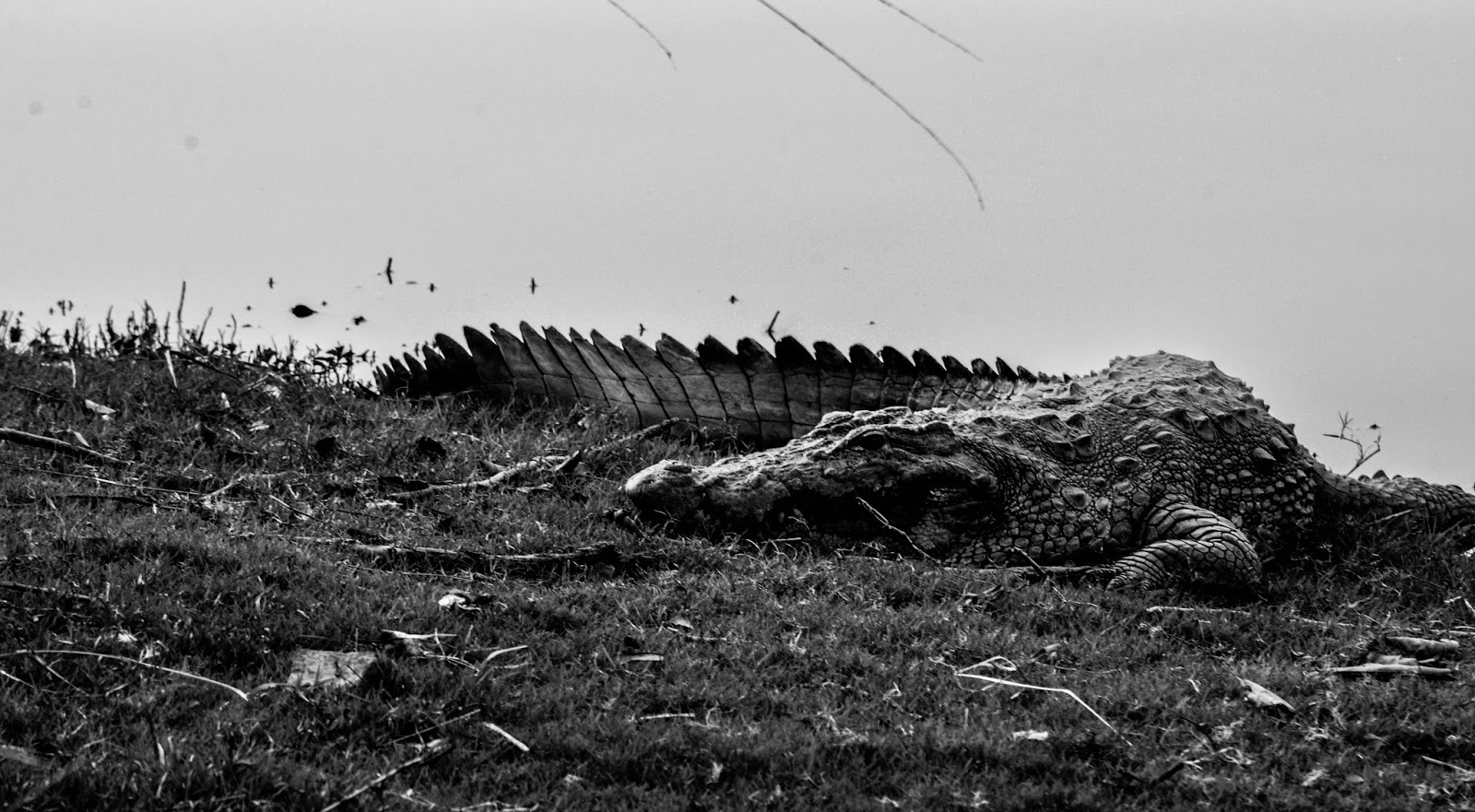
Grey.

Greyscale photography focuses on the details and shadows. The unspoken-of outlines that get lost among the bright colours surrounding them. While photographing an animal or a bird, it draws attention to each shaft of fur, each whisker, the dull tones on the underside of a bird's wing. It allows one to appreciate the animal and the moment for what they are - the muscles and sinews, the veins and angles. It lets you play with the sun and discover how it plays with your subject, in turn. 

When I look at a black and white still from when I was behind the camera, it takes me back to that moment and freezes it in time. I can relive that moment with a clarity greater than a coloured image would let me, and that touch of palpable recollection is why I love using this palette. It's why other greyscale photography gives me goosebumps and penetrates my mind with a sharper ferocity than any other kind. 

It's easy to fall in love with vibrancy and  bright hues. But to look into the dull depths of a grey canvas and discover life within is to truly understand and love the animal despite the colours it wears.


Monday, March 28, 2016

The Art of Pretending to be Fancy

Living away from home comes with several perks and nuisances. I’ve found that cooking falls under both those categories. Tanisha and I are lucky, because we enjoy food and cooking. However, that means we spend inordinate amounts of time in the kitchen preparing each meal, trying to make them as interesting as we can. It’s safe to say that the novelty is beginning to wear off, and that the prospect of cooking makes us consider stepping out for a cheap dosa or a plate of chaat…often. But our limited supply of money keeps us in the kitchen on most days, and we’ve plated many a masterpiece.

I shall now conceal from public view items like aromatic burnt khichidi and dry parsley-mint sandwiches, and share these with you instead.


Garlic mushroom salad


Baby potato garden salad


Dalia (broken wheat) upma


Shezuan noodles with mushroom and capcicum


Spaghetti in green pesto


Spaghetti in tomato sauce with mushrooms and cheese


Vegetable shezuan fried rice


Vegetable hakka noodles


Spaghetti with tofu and baby corn


Jeera rice


Sprouts


Yellow dal fry


Tabbouleh


Open-face vegetable pizza

Yummy, no? 
Yes.
Very.

Wired


Black-winged kite


Pied bushchat


Indian roller


Black drongos


Barn swallows