Showing posts with label life. Show all posts

Sunday, May 16, 2021

Day 48: Nicobar Diaries

25th December 2017

Christmas. And now thirteen whole years since the tsunami wrecked havoc and changed the lives and personalities of nearly everyone on this island. 

I just made myself a stiff cup of tea and an omelet. My white-dog visitor, who trots in through the back door every morning is now looking at me with pseudo-paavam* in his eyes. He seems disappointed about my lack of leftovers. My rice-and-potatoes from yesterday have clearly raised his expectations, and my stiff roti isn't doing anything for him tonight. (It's averaging 40 degrees C with max humidity - I'm without a fridge and can't store anything, so I'm finally learning to cook for one.) What a darling, I still can't bring myself to name him.**
~~
Post-chai: Helene Hanff once signed 20 copies of 84 Charring Cross Road for some booksellers in Australia on 26th July 1971. The inscriptions say 'To an unknown booklover'. I had a brief moment of tearful eyes imagining holding one of those 20 books in my hands. 

I am very emotional these days, and I break down a lot. Living alone sure lowers one's inhibitions. 

Also - Helene was alive until 1997 - it's thrilling to think we overlapped for three years on this planet, although we would have been wrinkly (for different reasons) and far away from one another the whole time. 

Today's idle pondering led me to think about how I have the mind of an introvert but the heart of an extrovert. That the things I love to do, or dream of turning into a career, involve long periods of solitude or time with my thoughts. Too much time with my thoughts, though, can get a bit much. Apparently, I can think at 150 kmph, especially during long scooter rides at 30 kmph. I wonder if I'll ever strike a balance between these different versions of myself.

Yesterday was a long day, as were all the others between my entries. I've been distributing my citizen science calendars all over the island and it has taken me into the homes of a wide assortment of people and tugged viciously at my heartstrings. I had already given out ~100 by the 23rd, and had hoped to cover as many homes as I could (5? 10?) - holiday haze had already set in. 

The first family I visited was supremely enthusiastic about my work, and took me all over their plantation to show me some of the damage 'my' monkeys had caused - eaten coconuts left atop leaves or dropped to the ground, banana trees that had clearly been ravaged, some without a single fruit left on the stalk, young trees that had been killed because the monkeys yank out the apical bud which is full of juicy nutrients. They had put nets around the plantation, but I couldn't understand how they could ever work; they were no more than five feet high and the monkeys would have no trouble getting over them. A lot of these precautions are well-meaning, but fall short in execution because of the inordinate time needed to see them through, or their in-affordability. Monkey-proofing isn't cheap, and their steadfast problem-solving abilities don't help. They also have dogs tied around the farm that seem to be one measure that works - I later discovered several dogs kill monkeys during altercations; everyone keeps it mum, but they don't stop it from happening either. 

By this time I had already spent over an hour there, and they welcomed me into conversations like we'd known each other for months. Being Sunday, the two lounging brothers and one of their daughters offered to show me the Joginder Nagar beach where sea turtles come to nest. I agreed even though I'd been there before, and I'm glad I did. I got an in-depth tour of the areas where the tsunami hit them worst; where the old road used to be, how far the fields once stretched and, of course, the turtle nests. They seemed happy to have someone to remember the fateful day out aloud with - perhaps it was just the time of year. There aren't many nests so far, it's still early in the turtle season - one leatherback and four olive ridleys. One of the brothers mentioned that the appointed forest guards tend to inflate the number of eggs laid every year to maintain Joginder Nagar as an important place for turtle nesting. If not, they could get posted far off in Galathea***, and no one wants that if it can be helped. I followed them on my scooter along tire-width sand tracks by the coast to come to a tiny lagoon where one can occasionally see saltwater crocodiles. We returned to their home around noon after the informal tour, where the brothers said they were impressed with my skillful riding along the narrow gullies, when in reality I was certain I would skid the entire while. My stomach had unclenched only when my wheels hit tar again. 

For those who depend on agriculture/plantations, life isn't easy. They need to be (and have) watchdogs everywhere. Along the coast, they face cows and need to smear cow dung over the young trees to keep them away. They showed me the older coconut trees that were still standing after the tsunami. The point where the water hit them had shriveled, and all the growth ever since has been narrower than the rest of the tree. Some of them don't even fruit anymore. 

After much chatter and now with an irrefutable camaraderie, I ended up having lunch with them after all. Now, in the late afternoon, I realized there wouldn't be any point visiting more homes that day - everyone was either leaving to go to the Gurudwara or preparing for Christmas. After they (excitedly) shared some photos of a couple of whale strandings that they told me about at Joginder Nagar from years ago, and of them siting on a pregnant leatherback turtle (this seems to be a trend among the islandic youth), I took their leave and headed home. 

Enroute, I stopped at Mugger Nala to sit by the sea for a while, which was, as always is, lovely. I welled up again. It's been an overwhelming month so far - the travel, the solitude, the home-hunting, the forging of new friendships, the disappointments, the seemingly endless monkey-caused strife, building empathy, the independence, the grandeur of the island, and the helplessness of it all. I then felt tired of feeling so listless and sorry for myself and decided I'd go to the community church for midnight Christmas mass. I drove up to a sweet Nicobarese home I had visited before and enquired about the specifics of their celebrations - I'd come prepared. I purchased a Nicobari lungi and stitched it up for the night. I love it already and could live in it, they are uncomplicated and comfortable to wear, especially in the humid heat. (I also finally managed to get some good vegetables in the bazaar.)

Time to go find my monkeys - more later.

--
* paavam is a Tamil word that implies 'poor thing' 
** My neighbours and I did, ultimately, agree on 'Pandu'
*** Galathea is a bay at the southernmost part of the island, far removed from the villages and separated by ~5km of forest. It's quite a grueling posting for the forest guards, and rarely their first choice of work place!

Friday, August 21, 2020

Locked In

 Dear Readers,

I write to you from an elite sense of entrapment, with supplies being delivered at my doorstep, garbage magically disappearing and the self-fulfilment of staying indoors and contributing to ‘flattening the curve’. While I sat in my balcony this afternoon feeling sorry for myself, running my mind through clichéd thoughts of knowing the value of freedom only when it’s taken away, I tried to remember the last time my movement was this strictly restricted. 

My mind took me back to 2005, when I was still in school and my only worries were unit tests and mid-term exams. The state board curriculum that educated me was dull in every manner, and I’d always put off studying until unavoidable. I was thankful for any delay in my need to commit text to memory, only to purge my brain of it all the very next day in a half-dazed flurry of ‘Answer in Brief’ and ‘Give Reasons’. To add insult to injury, my first set of exams each academic year coincided with my birthday. I could come to terms with not being able to distribute sweets to my classmates or have celebrations, but having to study on my special day always seemed cruel. That year, however, had other plans for me. 

I remember sitting at my study table in our 2BHK in Bombay, overlooking a narrow street, reading reluctantly for a geography exam the next day. My attention would often drift to the window in front of me, staring into the downpour that hadn’t let up for the past two days. Bombay rains have always been an intrinsic part of growing up, a sign of good luck and respite from harsh summers. For a young school girl, heavy rains also came with the hope of school holidays and half-days. My selfish thoughts would wish for our reliably blocked drains to clog up and relieve me of my books and teachers every time it rained for over two hours. This day was no different, and I crossed my fingers and muttered in hope to the clouds for them to keep showering until the next day - my birthday - was declared a holiday. 

It was 26th July 2005. By noon (and 2 of 8 chapters in), the water had risen to an adult’s knees or an adolescent's hips. I climbed into the box grille and watched cars chug to a halt, people wading in opaque, brown water and the strewn garbage from our street floating to the surface to get caught in drain currents. At the corner of my lane, I saw how the water began to pour into a small hole in a building wall. Frantic, a whole family of rats was swimming against the gaining water, trying to find higher ground. Full-grown rats had emerged first, their fur matted and glossy from being drenched. They stood on a fine ledge, urging the semi-hairless young ones to follow them out of their once-dry home. That visual is still so vivid in my mind, and I can imagine the squeals that must have filled the air at that spot.

I was conflicted – was I happy about this incessant rain or was I scared of the consequences? I was, however, but an almost-12 year old, and found myself leaning towards 'happy'. Two hours later, I got word from school that our exams were being put on hold until Bombay dried up. I tossed my textbook in joy (followed by stern disapproval from my mother) and sat by the window watching the goings on for the rest of the day. Needless to say, it wasn’t pretty.

We were starting to worry about how long this would continue, and we only had enough supplies for a couple of days. Our electricity had been shut off for hours, and water had begun pouring into the ground floor apartments. In the evening, our downstairs neighbour thumped on our door. She was frazzled and asked us (the pet-owning family) to rush downstairs. A stray dog had floated into our building and had gotten badly stuck in a spikey grille by the scruff of his neck. He looked miserable and had no control over his body. He was exhausted. Barked-out. Fading. My father’s hands were too large to manipulate him through the burglar-proof grille. I knelt down in the cold, filthy water and slipped my hands right through. I pet the floating dog, who looked up at us for the first time since we found him. He looked straight at me, weak and shivering, with deep brown eyes. I could tell from the new ripples in the water that he was using his last bit of energy to wag his tail, responding to the warmth from my touch. I pulled him closer to relieve the strain against the iron, and released his skin from the menacing arrow in the grille. He jumped in the water and spun a little, immediately kicking off and away. I was terrified and happy simultaneously. I dreamed about the little brown guy that night.

The next morning, it was still pouring. I opened my eyes to my mother staring out the window with my sister on her hip. She looked worried. My father had decided to wade out and get some groceries and candles for the next few days - it didn’t look like things would get better any time soon. It had already been an hour since he left the house and I could see every shade of panic on my mother’s face, reflective of the worst-case-scenarios she was playing in her head. A neighbour had made things worse by striking up conversation about potholes and open manholes that lay hidden beneath murky waters. We sat together by the window, tense in solidarity.

Another two hours passed before my father returned. His characteristic knock on the door brought the widest smiles to our faces, and we greeted his haggard form with more love than he expected. His hands were full of bags, indicative of his successful waterlogged adventures, and we heaved a large, familial sigh. 

Later that evening, when the excitement and worry had died down, I was sitting in my room reading Matilda when my parents called me to the kitchen. I walked in to find them around the dining table in the light of twelve candles. Potato chips, a single pastry and three samosas filled the table. My father had wandered through the morning until he found a Monginis open and bought up the last surviving of their party snacks. I nearly cried. I had written off my birthday and retreated into quiet until this moment. 

Regardless of all the subsequent parties and warm gestures from friends and family as the years have rolled by, that one candlelit evening with shared laughter, the smell of deep fried samosas and gushing rain outside will always hold a special place in my mind. 

Yours in quiet midday reverie,

Ishika

Friday, December 27, 2019

Day 37 - Nicobar Diaries

14th December 2017

(I have no food on my table - plastic table and chair bought to aid work and provide one of those required surfaces upon which one can put things - and yet there are always tiny ants swarming over it. They climb over my arms while I work and then travel over the island with me.)

It took some time for things to get going once I got here. I spent two very long days on the ship, during which I had an attack of loneliness, a little breakdown when my cabin-mates weren't around and then wrote some cheesy letters to friends. It was only as the ship was approaching Campbell Bay - the three hours of crawling towards the harbour in sight - when I was introduced to Jaya and her daughter by the wonderful old man I spoke of, who chatted me up while I was looking for dolphins. Of all the introductions and meetings I've had so far, which is many, this one has truly blossomed. We've become dear friends seemingly overnight, albeit in a mother-daughter manner. She and her family (husband who works in the Stores for the Forest Department and two girls just younger than me) adopted me without taking no for an answer. They gave me a bed to sleep in while I struggled to find an empty shelter to rent for my stay.

Jaya still stresses out about my well being, especially if too long has passed since I dropped by for tea or a meal. I'll never stop being amazed by how hospitable people here can be. Coming from Mumbai where our door is often closed even to friends and family if unannounced, I wonder if I deserve such love and warmth. It's not easy being on either side of that door, and I'll be damned if I don't uphold Nicobari values well into my life.

With this family's help, a lot of asking around, riding around on my scooter, some begging and groveling, I convinced a Mr Murugan to rent out one of two shelters that had been left in his care. He said I could have the one without a working bathroom, having promised the "good" one to a family who was to arrive soon. He and his right-hand-guy promised to help me fix up the house within 3 days, during which time I moved out of the Government guesthouse and into Jaya's home. After a week of their call-dodging, false promises and my nagging, I finally received the keys to a semi-functional home. It took me some days and a trench in my stipend to set it up and clean - and I live to tell the tale.

Work-wise highlights

-- I decided to begin conducting my interviews from Govind Nagar itself, as I was still setting up home in that village and it helped to not travel too far in that time. I got my surveys printed, charged up my dictaphone and set out. My first two interviews were awkward. I realized this only later while listening to my under-confident self on the recorder. I have a terrible recorded voice, so child-like and high-pitched, why do people speak to me over the phone?

Anyway, I picked up pace, confidence and structure soon enough and have managed to complete most of my interviews for this settlement. I am much more fascinated now than I've ever been. The stories and experiences that I get to hear make me feel for both the people and monkeys. Looking at conflict through avenues that bring me closer to the affected and the affectee is hard on my thoughts about the situation here.

The interviews are varied and every home is different in the way its members respond. Some homes have enthusiastic interviewees who answer most of my questions even before they escape my lips. A couple of people have enacted their experiences or the behaviours of the visiting monkeys. Some people are willing to share, but feel their experiences aren't worth sharing. One old man was so busy cleaning rice, he took 20 seconds of contemplation to answer each question. Sometimes it's easy and fun and intriguing, and at times there are long, awkward pauses and smiles. And generally, there's chai.

Most of the non-academic details from my interviews are in a document I'm maintaining on the laptop. The optimist in me thinks there's a book to be written from all this, the potential is mind-boggling. Gently having mentioned this to Ma and Nana over the phone led to them recommending illustrators for the book I haven't yet written. The instinctive encouragement on their part makes me want to give it a shot.

-- I've nearly habituated my troop entirely and it's a humbling feeling. I don't take this trust lightly, especially since I know what it was like when I first started out. I'm following the troop near B-Quarry beach, decided to do so after piloting with 4 different ones. The others were either inaccessible in spurts or outside the anthropogenic gradient I was interested in. I think I made a wise choice with this troop, since their home range covers forest patches, clearings, human habitation and coastal areas. I'm constantly discovering new things about their behaviour that I'd enjoy delving deeper into later on. I'm keeping record of these ideas, they keep me engaged.

I met a pujari whose temple is just at the beach. He feeds the monkeys regularly, much to the dismay of some people. Sometimes he shouts out to me, informing me that they're arriving. Often I'm following them already, but I humour him and thank him heartily for the help. He's a Tamilian and chats me up whenever he gets a chance. I've now developed a short-short hand so that I can continue making observations while he tells me about his life, the monkeys and Lord Krishna. He's been inviting me to his temple for evening prayers, I think I might go one of these days.

The pujari offering some coconut prasaad to my study troop

While the macaques are a bunch of naughty goofballs in most people's eyes, I can't help but be in awe of them. At the end of the day, these are wild animals - brilliant, intelligent and full of personality. Maybe our shared mannerisms and diet make them so relatable that we overlook these things. I also realized that I underestimated the time I need with each troop - it's a combination of now wanting to delve deeper into each one and juggling the behaviour work with my social surveys. I'm wondering whether to stick to just one and get to know them intimately and reliably.

-- I had an idea for citizen science a few days ago, which Rana seemed to really like as well. I'm flying with it. I start tomorrow and am hoping ardently that it works.

Only 5 months to go.

Non-work-wise, it can get lonely. I don't mean to sound ungrateful for all that's happened so far. Many people have helped me, struck up conversations and welcomed me into their lives, but I'm ultimately on my own for the most part. What makes it harder some days is knowing that this past month has crawled past, and I know that there's 5x to come. The rational parts of my mind tell me that the first month was bound to be a stretch. I was setting up the whole project and my immediate future, stress being my side-order to every meal. Once work begins in earnest, days are bound to fly by, and maybe when they do, I'll wish they didn't. 

Saturday, October 5, 2019

Keep Safe Distance: The Hebbal Project

It's been roughly nine months since I began traveling 17.5 km to get to work each day. Considering I live in Bangalore now, where distances are magnified by its tipsy traffic and where daily cab rides at office-going hours could deprive me of large swathes of my own salary, I wasted no time in procuring a hardy second-hand scooter. My deep purple Honda Activa, albeit a little wobbly, has repeatedly carried my clumsy bottom to office and back loyally. She's squeezed through tiny gaps between cars and provided me with a false sense of progress in standstill traffic. She has whizzed past trucks too large for her own good - a trusty little Scrappy Doo in the big bad Bangalore world. She's rolled over many a pointy object, throwing me at mechanic after mechanic, patching up her well-worn tires. One would think traveling 35 km a day could get boring/exhausting/frustrating/excruciating/brain-numbing, but on most days, luckily for me, I had more than my personified scooter for company. I had a Dincy.

What is a Dincy? Oh, I'm so glad you asked.

A Dincy is a curly-haired female being. A textbook nerd (thank you, Dr Seuss). She is eternally fascinated by the world around her, taking it all in one hazy phone photo at a time. She is my default pillion, seated fixedly behind me in a good-for-nothing helmet of her own choice. From there, she points out the humour hidden in traffic - funny road signs, car stickers, dogs wedged into two-wheelers and oddly-shaped helmets. Our journeys are autobiographical, with people and our immediate surroundings reminding her of various anecdotes to keep me entertained with. But, believe it or not, this post is not about Dincies (if there can even be more than one of these strange creatures). This post is about Project Hebbal - one of her many cranial gems.


All photos taken by the aforementioned Dincy

At the start of this literal and metaphorical journey in February, we were stuck somewhere along an 840 m stretch of traffic bottleneck - as we still are on most days - called the Hebbal Flyover. This flyover is strategically planted, ensuring that most traffic going to school/office/college has to crawl over it. At two inconvenient spots, more commuters pour in, causing the existing lanes of traffic to squirm awkwardly out of the way.

One such inching day, Dincy decided to time how long we took to cross over. She did it again the next day, and the next, and the next. We agreed that we could find the optimal time to cross over Hebbal if we kept meticulous note of when we reached the flyover and how long we spent on it. It became our pet project (and a convenient way to justify when we left our homes later than planned). Being the sole scooter maneuver-er across our many 'data points', I have come to claim equal authorship over our several month long academic endeavour. I present to you, our findings.

How long it took my Activa to get over the Hebbal flyover (840 m) at various starting points in the AM - a liberal scatter that is explained below.

It took us an average of 6 minutes and 21 seconds to cross over, clocking in at an incredible pace of 8 km per hour. I must admit that this was rather disappointing, because on most days it felt like half an hour, considering we were often running late as well. However, allow me to now elaborate upon the many confounds that our project is rife with.

#1. These results are only applicable to travel by scooter - a rickshaw would take 2-3 minutes more, a medium-sized car would take 3-4 minutes longer, and I'm certain that buses would inch along slower still.
#2. My scootering skills: As the days rolled by and frustration with everyday traffic increased, I got more proficient squeezing through narrow gaps and maximising on wiggle-through opportunities, shaving off more time from our data than when we began in Feb.
#3. Between April and June, we had some blissfully traffic-less days despite being tardy thanks to schools being closed for summer, reducing much of the traffic (informed speculation!).
#4. There is a second route (via Hennur) one can take to the office, bypassing the mountainous Hebbal, which is longer but allows for uninterrupted movement. I've found it usually takes even longer than if I persevered through the flyover traffic, however, it's worth it for the maintenance of sanity. Because I take a look at the vehicle pileup and reroute through Hennur, we have missed several data points that would have held us in place for 10-15 minutes. Somehow, it wasn't worth it even for science.
#5. Traffic policemen! Most of Hebbal pileup is because of the chaotic manner in which people force their way through unmoving traffic at the two inlets I mentioned earlier. On occasion, there has been a traffic cop at these points, directing traffic, helping things move along like butter. Well, semi-solid butter. This has shaved time off of our timer and proven how having someone stationed there regularly could have saved us the trouble of starting this project in the first place.

So, what do you do with this information? You can use it to determine when to leave home in order to beat the rush or simply use it to know that you're not going to beat the rush because you left late like we generally do.You could use it to ensure you don't take the flyover into the city close to 9 am unless you absolutely must. You can use this to prove to the Bangalore Traffic Police that we need to address this bottleneck because there is now somewhat hard data to prove that it should not take more than a couple of minutes to cross 800 meters of road. You could also use it to feel better about yourselves, knowing that you didn't spend enough time stuck in traffic to find an internal urge to study your time in it. The possibilities aren't limitless, but plenty.

In the meanwhile, we shall go back to navigating through incorrigible traffic, dodging people who never use indicators and overtake from the left. Dincy will keep taking photos of odd happenings and I will continue to resist the urge to honk back at the Uber driver who thinks I can make way for him in the middle of a red light.

Saturday, September 14, 2019

Day 12 - Nicobar Diaries

20th November 2017, Andaman Sea

(A filler post - pieced together from incomplete jottings and to-do-lists)

Coral Queen is swanky. Okay, not swanky in the literal sense, but swanky in comparison to M. V. Campbell Bay that I took the last couple of times. It's a tinier ship, something I found endearing and novel until bad weather and halpa (the sea-equivalent of airline turbulence) hit us. When docked, it looked sturdy and bold, like a short-yet-feisty person, but appeared rocky and dainty once out at sea. Like a Victorian relic washed abroad due to torrential, tropical rain.


This journey, like the others, was a solo one, or so I thought. I had two days of solitude, a good book, a pair of binoculars and a ship full of people who'd soon be my neighbours. I was covered. Typically, I'd find myself on the deck through the daytime hours - binoculars hanging around my neck and book in hand - scanning the seaface for cetaceans or any marine life between chapters, or leaning over to look at the tip of the ship as it breaks water, sending flying fish in panic-stricken directions. The latter wasn't as possible as I was accustomed to. Owing to the tininess of the ship, a thick rope boundary was drawn between the railings and the passengers, leaving a wide berth of tempting deckage restricted. So, I shared bum space with many more people per square foot than anticipated, striking up conversation between sentences. 

An elderly man - thin and distinguished grey, with the slightest slouch of the shoulders - walked up to me and asked me if I was the 'scientist type' - he had seen me writing and reading for a day. I gave him the modest truth, being careful to sprinkle the word 'student' into my description generously. He asked me if I had a place to stay when I got to the island. Fact was, I didn't. I was going to spend a few nights in the Forest Guesthouse while I scouted the area for a place to rent and turn into a field base. He insisted that I meet Jaya.

Jaya was the center of a small group of 5 women, draped in a bright blue saree with her short hair tied up tight, not a single strand out of place. Once he pointed her out to me, I couldn't help but notice her and her exuberance. She was loud, high-pitched and had a smile plastered on her face constantly. He introduced us and I was whisked away, into the group of chattering women. We went to the dining area, where they were sharing a 15 rupee packet of banana chips, and a barrage of questions followed. They were bored on this long journey and there I was, a serendipitous source of entertainment and intrigue. Who was I? Where was I from? What was I going to do there? Why am I traveling alone? Wasn't I scared? Do I get paid to do such outrageous things?

Providing honest answers, I've found, paves the way to receive more information than I imagined/wanted/needed. Nonetheless, it builds relationships, and I didn't realize what a rock-solid family I was steadily becoming a part of that first evening aboard Coral Queen.

Over the next two weeks, Jaya Aunty became something between my islandic older sister and mother. She put a roof over my head and food in my plate for two weeks while I scrounged the place for a house to rent, began scouting for field work and steadily began conducting my interviews. She also gave me the seeds of a few vessels to make tea and rice, a plate to eat out of and a mat to sleep on when I finally found a place. 

When I first walked into it, it was extremely dusty, had fungus all over its plywood walls, a fan hanging precariously on its hinges and several broken pipes. It hadn't seen electricity coursing through its wires for months, and it was hard to believe that it was ever occupied. It took several trying calls, personal visits and more scrounging to find resources and people who could help me restore it to a place I could spend six months in. It's hard to have a sense of urgency in a place that seems to function along its own timescale, moving imperceptibly in the Andaman Sea. With my scooter as a sole assistant, I steadily put together a field base, set up in Tsunami Shelter 6A of Govind Nagar, Campbell Bay. Its large hall had but a plastic Nilkamal table and chair. One bedroom lay empty and the other held everything that I brought with me in my rucksack, neatly piled around my sleep-mat. The kitchen started bare, but appeared lived-in as days went by. I shared my outdoors bathroom with 3 friendly chickens, 4-5 goats, my neighbour's cow (who kept trying to worm her way into my kitchen) and, occasionally, the ranging macaques.


A week into living alone in my tsunami shelter, two neighbourhood dogs - Pandu and Chotu - began living with me. I had a home.

Tuesday, April 30, 2019

Day 10 - Nicobar Diaries

18th November 2017, Haddo Warf

This was my last day in Port Blair before heading off to Campbell Bay in Great Nicobar, and it was a long one. I started the day making long lists of things to do, buy and pack before getting on that ship. I also had to find good network and internet to send some emails to the officials at Campbell Bay confirming my arrival dates (now that I had tickets) and follow them up with phone calls to account for all bureaucratic and internet-related inefficiencies in Great Nic.

I had also discovered two things:
1. My scooter was giving me great mileage.
2. I wouldn't be allowed to load my scooter onto the ship if it still had petrol swishing inside its fuel tank.

I decided to set out early and run all my errands in a non-parsimonious order so as to use up maximum fuel since I filled her up entirely like a fool yesterday. Since I didn't know about photocopy machines and printers in Campbell Bay just yet, I also got some data sheets and permit letters in place. Since the island authorities keep track of every new person to set foot on the island, I also got my photo taken, so I could attach it to my application. It turned out blurry-eyed and sweaty, with large patches under my pits thanks to the sweltering day and my running around.

The cargo ticket said I needed to be at the loading docks by 5 pm. I hurriedly finished all my work by then and reached Haddo. This is a fairly large dockyard from which the heavier passenger and cargo vessels leave. It has multiple entries - all leading up to the same places - but open at varying times. It has broad walkways and cement platforms, large enough for trucks and cranes of immense girth to pass through. Having to walk from one end of the docks to the other takes forever, and the expanse of platform seems never ending. It's got 30-foot-long shipping containers piled up in colourful columns to one side, which I've only been trained to look at as a potential site for an action/horror film shoot.


I had to sign myself and the scooter into the docks, providing the necessary paperwork, and was then let in. Once I got there, though, I found four others with their two-wheelers, making multiple rounds of the wharf to use up their remainder petrol. My tank was so far from empty, I felt even sillier. I needed to find a way to manually empty it there itself, now that I had done the long-drawn entry procedures. In addition, I was told that it would easily be another three hours before the crew would get around to loading our bikes. These would be the last cargo to go in, after all the other inter-island supplies, that came with their own sarkari paperwork which had to be checked by the Captain.


In all that time waiting and twiddling thumbs at the dock, I made conversation (dare I say friends?) with the Captain and few men from the crew. They were all pretty helpful and sympathetic about everything taking so long. Two others who had a little too much fuel in their tank used mine (with the most petrol) to scout for pipes and bottles that we could use to suck out the excess. I had nearly two liters still inside, which was great news for mileage and scooter potential, but a real pain at the docks that evening. The yellow fluid was like precious gold, and everyone stood clutching theirs cautiously so as not to mix it up and end up with less than their rightful share. Once the accessible petrol had been drained, we left our scooters on and running to burn up any traces that may still be there. The Captain would walk by, rock our bikes side to side and give us a disapproving shake of his head if he felt any swivel. My conscience burned with the petrol.

It was past 8:30 and very dark by the time our tanks were dry and in line to be loaded. I walked the scooter up a narrow, angled plank into the bottom of the ship, now filled with vegetables, fruits, mechanical parts, fish stock and other supplies. After watching these things being transported into the ship's hold for nearly four hours, I was amazed to see so much room still available. I then strapped my scooter in with scrap ropes to some potato crates and left after saying hearty byes to the crew and others at the dock, as though I'd known them for years.

Since it was already so late, I had long missed the last bus heading home. I requested Ravi, ANET's trusty cabbie, to come and get me. I got back to the base at nearly 10. I gave Sachin (another researcher) all my extra free fuel for which he gave me a rare smile, had some cold dinner, packed up my bags and crashed.

Lots to come.

Sunday, April 28, 2019

PCOS - Periodic Curtailment of Sanity

It's now been twelve years since I was diagnosed with PCOS. While I've come to accept and live with it wholeheartedly, I still send a loving barrage of disappointed expletives to my uterus every month. Or every other month. Or every few months. Or twice a month. All dependent on how often my ovaries choose to throw a physiological tantrum.

PCOS, or Poly Cystic Ovarian Syndrome is a complex hormonal disorder which affects about 1 in 5 women in India, albeit in very different ways. Even though it's something so frightfully common (where mentioning I have PCOS triggers multiple, "so do I!" responses among my female friend circles) it is widely misunderstood, or simply not understood. Put lightly, PCOS is an imbalance in the release of 'male' and 'female' hormones. Often those with PCOS have higher levels of androgen and testosterone which throws the regular 28-day menstrual cycle off whack. Periods become irregular or may not come at all. The ovaries often collect fluid in and around their developing eggs, forming cysts. Because of this, the cysterhood of eggs stick together and may not release into the uterus in a timely manner.

This syndrome (or way of life, as I have come to know it) could occur due to increased androgen levels or genetics (brought to you by sexual-selection-avoiding humans). Both these leave you predisposed to PCOS, at times manageable through stringently maintained, painfully healthy lifestyles.

While it's difficult to explain exactly what's going on inside my body to someone who's never had to deal with PCOS - or in the case of men, with periods itself - it's actually pretty straight forward. PCOS could lead to irregular/scanty/heavy/no periods. It could manifest as acne, hair loss, weight gain (hello, my puberty), facial hair or the inability to conceive. However, it doesn't mean every woman has to put up with them all. I have to deal with weight gain, hair loss and severe cramping regardless of whether an egg descends from my ovaries that month or not. Someone else may break out with acne despite being twenty years out of their teenager phase and still have just the right amount of adipose. Fact of the matter is, it's a pain and we don't know what's going on with our bodies either. Sadly, in the long run, PCOS isn't just a monthly bother. It could pave the way to obesity, heart disease, infertility or diabetes.

While my reproductive organs down there are taking holidays and see-sawing on imbalanced hormones, my brain wallows in confusion and disorientation. PCOS causes mental and physiological stress, since the body is constantly trying to cope with unpredictable cycles, fluctuations and discomfort. In addition, it leaves one vulnerable to depression, anxiety and eating disorders. I've been battling with societal depictions of what the ideal woman ought to look and feel like for years on end, and body positivity does not come easily. How can I love my body when it feels like it doesn't love me? It's a cyclic conundrum, just like my primary dysmenorrhea (the uterus never stops throwing curve balls).

Having symptoms crop up through the cycle (or another non-round shape) each month has taken me down many a Google search, desperate for answers, solutions or comfort. But all this has ever done is is feed my reason for worry. I've assumed the worst, like ovarian cancer, convinced myself of parthenogenic pregnancy or thought I was abnormally messed up in the lady parts. Fact of the matter remains that a gynecologist is always the one to provide maximum emotional comfort - provided you find a non-judgmental one. Since PCOS affects each woman so differently, it's terribly hard to find universal symptoms online - or even the right combination - to fit everything you're going through perfectly. Only a gynecologist can listen to your woes, look you in the ovaries and assure you that it'll be alright (maybe with a little customised treatment and exercise). No matter how much inertia there may be, it helps to visit one, just for the peace of mind if not solutions. You'll be okay. I'll be okay. The entire cysterhood will be okay. Not great, but we'll take what we get, just like our PCOS.

Saturday, April 20, 2019

Day 8 - Nicobar Diaries

16th November 2017, Phoenix Bay

Visited Phoenix Bay today since the Directorate of Shipping Services (DSS) was being absolutely useless.

Phoenix Bay is where one has to go to book tickets for inter-island ships. It's an ancient first-come-first-serve process, where islanders and visitors far exceeding the number of available seats queue up outside the office at least three hours before the counter opens in hope of securing a bunk out at sea. When I was there for my recce in June 2017, it took three attempts and a cumulative effort of 15 hours of standing in sweaty lines before I got a ticket aboard the M. V. Campbell Bay to Great Nicobar. 

Ship timings are erratic, as are the schedules for when the single ship designated to the route you're interested in leaves the Bay. A couple of days before the ship is to set sail, a short ad is put in the 2-page local newspaper 'The Daily Telegrams*' following which, a mad rush of people gather outside the booking office a day before departure.
After combing through the Daily Telegrams every morning in the hope of finding a ship that leaves soon and trying to get through to the DSS that simply responded with a bored, "We will advertise when there is a ship leaving" I figured going to Phoenix Bay in person was the only option. Sure enough, there was a ship for Sunday (19th) and tickets for it would be sold on 17th - tomorrow! I called Naushad immediately and decided to get the scooter from him today itself so that I could ride it to the office earlier than the first bus from ANET and ensure that I get a ticket.

Dayani (who had motor-biked me into town) and I ate at Golden Dragon near Gol Ghar. It's a very homely place tucked away on the first floor, enclosed behind a grill door that is opened only if you ring their doorbell. A Chinese couple moved to Port Blair and started this restaurant there, although it feels like they've had to 'Indianise' their food regardless!


Around 4 pm, I bought the scooter. I was extremely excited and felt like the adrenaline of having to stand in line tomorrow had already kicked in. I even bought some snacks for the queue, keeping in mind how hungry I got in the past. I made sure all the papers were in place and left. I spent some time in Garacharma filling up the fuel tank and fixing up new mirrors. It was nearly 5 pm by the time I headed back to ANET. Darkness fell as I was nearing Manglutan and my headlights flickered weakly to a stop. There are no streetlights along that stretch, and a tiny Ishika sitting in my chest let out an internal scream. I made slow progress inching towards a tiny market along the way making use of when other vehicles passed me with their high beams and squinting in the moonlight. Luckily I found a place where I could buy a new bulb and convinced a closing mechanic to fix it up for me. It was nearly dinner time when I got back.

James** really liked the bike and thinks I got it for a steal, given the condition it's in. He played the guess-how-much-this-scooter-costs game with whoever he could find and beamed in his subtle James-like manner when its price was overestimated.

I was exhausted post-dinner and decided to turn in quickly despite the going-away party for a snake researcher who had been around for the past week. Since I had to be up and about for tomorrow's ticketing, I didn't face much resistance.

Before turning in, we had a short gathering at the dinner table about ANET's plan to have an 'open house' of sorts, where the base would be thrown open to all the residents living around it. There's always been a vague question-mark air among our neighbours in Wandoor about what all of us do at ANET. There will be stalls and props and visual representations of all the work that goes on behind our gates (which in reality are rarely kept closed). It's on the 14th of Feb next year and seems like a genuinely great idea. I hope I can come back to be part of it.

________________

*The Daily Telegrams is a double-page newspaper that is circulated within Port Blair. We usually read it a day late, since one of the ANET staff who lives nearby is the only one who subscribes. He brings it to us a day after his family is done reading it. The front page usually has very local news about ceremonies held, some politics, often a programme where someone was awarded a book or certificate, etc. The two pages inside have ads, vacancies, obituaries, birthday wishes and other birth-wedding-death announcements. The last page has some sports news and notices about shipping schedules. It's the cutest 4 sides of islandic information you'd ever come across.

**James is a beautiful man who has been part of the ANET field staff for many years. He's extremely curious and intelligent, and loses no opportunity to learn more about natural history. He can ID plants and birds better than most people (researchers included) on-base. All this being said, he's extremely modest and hard to impress, which means you have to have spotted something super rare to get his eyes to widen a millimeter more than their usual size.

Thursday, April 18, 2019

Day 7 - Nicobar Diaries

15th November 2017, Bazaar

The whole Cotton's college gang and anyone else who was awake at ANET went for a bird walk (I'm realizing most days have begun this way). By the time everyone was up and ready and full of chai, it was sunny and too hot for real birding. Akshay and I skedaddled by 7:15 am since we had some stuff to get done in town. Also, Akshay had to reach the bazaar in time to buy a ticket to Baratang. It was going to be a while before I'd see him again, so I tagged along even on menial tasks.

We managed to get a ticket and had a little time to kill until the bus was to leave, around 12:30. We had multiple coffees and he shared some wisdom about owning, riding and maintaining a scooter.

Even though there are a bunch of people at ANET even now, it felt pretty empty after he left. I guess that's the difference between small talk and real talk. 

Sunday, April 14, 2019

Day 6 - Nicobar Diaries

14th November 2017, ANET

I spent much of the day on campus at ANET. Worked on all my remaining datasheet-related tasks, which wasn't much, and finished writing up the proposal for Chandan and Paro's 'Pakke in Macro' film. 
About 3-4 months ago, two forest rangers from Pakke Tiger Reserve came to the National Centre for Biological Sciences (NCBS) to screen a film that they had made on-foot in Pakke. It was extremely impressive, especially since all the footage in it was shot by forest guards who were patrolling the area. They knew the land closely, and captured behaviours that a visiting filmmaker probably wouldn't have the chance to witness. Chandan and Paro, the two primary filmmakers of the screened documentary were truly enjoying their cinematographic learning, and were keen to make a follow-up film shot entirely in 'macro'. For this, they needed funds, equipment and someone who could help getting them. I offered to be that person. I had been working with their ideas and wish lists for a proposal, which I finally put together today.
With some scrounging for internet, I finally managed to send it off. A huge tick off of my to-do list. I don't know why I end up doing a multitude of tasks when I already have a lot else to do, but not when I'm perfectly free and available to tackle tasks in a timely manner.

By late afternoon I was mighty restless. I felt trapped and suffocated, like a month had passed since I left Bangalore. I decided to take a walk up to ghumai and get a samosa or something - anything to get OUT.

Spoke to Chandy on the way down. He's still waiting for permits, but is enjoying the birding, falling in love with the sunrises and swooning over the new-found skies in the Himalayas. I'm slowly starting to realise how much I care for all these guys, and how long these six months apart are really going to be especially after our constant co-existence for the past three semesters.

By the time I got back, Dr. Narayan Sharma (a former PhD student of Rana's*) and his students from Cotton University had arrived at ANET for the night. These students are of the first batch of the course for which Narayan is Head-in-Charge. He is clearly well-respected and admired, especially because of how hard he is trying to provide these students with as many experiences and perspectives as possible. He's the sole permanent faculty at Cotton's right now, and this can't be easy for him.

We spent about an hour before dinner doing introductions and speaking about our (all the researchers on base) ongoing or prospective projects. For a bunch of 20- and 21-year-olds who had had a full day of travel and no food in their bellies, they were extremely patient.

I had a long chat with Narayan after dinner. With his calm demeanor, pot belly and pollo t-shirt, he reminded me of Rana. He discussed the social angle of my project quite extensively and said he would send me a textbook on survey methods which covers the entire process - including how to prepare a questionnaire. It was lovely to have an ecologist-primatologist so keen to discuss the 'people' aspect of my work, since I still had the least guidance in that regard, and I didn't want to mess it up due to unintentional ignorance. He's an extremely warm and gentle person, and I can sense why Rana thinks of him so dearly.

Before turning in, a few of us went out on an owl search once more with the old-yet-enthu Vice Chancellor I mentioned a few days ago - he had stayed on a little longer. He's a very kind and articulate man who walks with purpose, with a camera and binoculars hanging off of his shoulders. We saw a hawk owl once more - it had bright yellow eyes and gave off red eye shine. On that particularly dark night, it was quite something. No matter how noisy the congregation of birders, the silence that follows a sighting like this one tells you more about it than words can.

A lot of fraternizing happened in general today in the library, which was fun on the whole. I find that even lighthearted chatter and tangential conversation in that library or around the dinner table tends to teach me a smidgen more about the islands than I previously knew.

Akshay was preparing to leave for Baratang tomorrow. Also, Naushad (scooter; Switz) and I agreed on 22 k. The day got better post-samosa.

________

*Rana is the pet name for Dr. Anindya Sinha - my lead adviser. He's one of India's most renowned primatologists, and it still tickles me to think that I've gotten to know him so closely over the past two years, when I was utterly star-struck and afraid to speak in his company when I first met him.

Tuesday, April 9, 2019

Day 5 - Nicobar Diaries

Today was an uneventful day. Akshay and I went around town running some errands. We printed out some data sheets, permit letters and then checked a few more places for a reasonably-priced second hand scooter. After looking at the garages and showrooms we knew of and coming up blank, we went to Switz for some tea (They have surprisingly tasty milk tea, even though they never advertise it. The tea simply appears from their closed kitchen door if you ask for some).

While paying up, Akshay took a chance and asked the cashier if he knew anyone who was looking to sell their scooter and JACKPOT. He wanted to sell his own. A black Activa of the H-series, four years old. I love how accessible people can be when you're in the islands. The inhibition to approach someone new and talk about anything drops several fold.

He wanted 25 thousand for it. We exchanged numbers and I test-drove it in the evening before heading back to ANET. It rode really well. It didn't have mirrors, but that's one of the easier and cheaper things to get fixed anyway. I asked him, Naushad, to consider giving it to me for 20 k and we left each other to mull over the offers. My project funding hadn't kicked in yet anyway, so I was in no hurry to part with money.

Akshay and I got a lot of inescapable time together today - bus rides, rickshaws, tea kadais and wifi cafes. It was nice - like a reassurance of what I already knew was a good friendship with the potential to last. Too bad we're going to be working at the two extremes of the islands.

Day 4 - Nicobar Diaries

12th November 2017, Chidiyatapu

Woke up early this morning to head to Chidiyatapu. It's about 1.5 hrs away from ANET with a bus change halfway through.

There's a biological park there with a handful of well-maintained enclosures for reptiles and mammals, along with a campus full of labeled large trees. It's a peaceful place to look at plants, work on tree-identification and simply go birding. I came to love the place, especially in the mornings before tourists came by, during my stay in the monsoon. I was stuck in Port Blair for 10 days longer than I intended to be back then (thanks to the fast-filling ship seats). I used that time to interview fishermen early in the morning and then watch the captive macaques at the Chidiyatapu Biological Park until it closed. I'd take the early bus towards the park, often with rain trickling into my useless raincoat through cracks in the bus, and get there in time for a cup of tea and samosa before it opened for the day. I came to know the Keeper fairly well in that time, and he would tell me colourful stories about the macaques' exploits (since I was his only available audience). I maintained a tiny notebook of what the monkeys did during the day, often dozing off in the afternoon along with them. They would roll their rotund, overfed selves into the shed in their otherwise open-aired enclosure and snooze in a primate bundle. I would sit on the tiny bench under the tiny roof opposite their enclosure, drenched from the rain, falling asleep over my soaking binoculars.

Although I was up and ready to head out early to the park like I used to, Akshay, Dayani and I soon realized that the rush of the Andaman Avian Bird Club (wonder why the felt the need for 'Avian' and 'Bird' in their name) would still be there till 10 am, owing to it being Salim Ali's birthday. We figured that it made little sense to set out that early and skip breakfast. Then, we noticed that Johnson* was making roti and chole, so that sealed the deal.

While walking down to the ghumai** later, we birded. We saw a juvenile crested hawk eagle and a HUGE flock of white-rumped munias. I've never seen so many together and up-close. They were mini-murmurating between the telephone wires and a rice field. Their calls seem like they're coming from way beyond - a gentle chatter lost in the breeze.


We got to Bathu Basti (en-route to Chidiya) only to realize that the next bus to Chidiyatapu was 1.5 hrs later. We killed time and money at Switz and ultimately took a rickshaw for lack of patience. The drive was lovely, as always. The blue of the sea had returned up to the shore post the monsoons (although it's still the season for occasional downpours).

Since we hadn't done lunch yet, we bought some samosas for later from the Aunty next to Cafe Infinity. She recognized me and asked where I'd been this whole time, leading to a small conversation in Tamil. It's always nice to be remembered by someone you remember well.

For the first time since my visit with Tarun, I did a whole round of the place with Dayani - I used to head straight to the monkeys ever since. It took us about half an hour to reach the monkey enclosure this time. I felt immediate relief and affection - a combination of emotions I reserve for seeing Chaplin*** healthy and well after a long time. The two juveniles were much larger than I last saw them. They were still in the maximum-time-spent-clinging-to-mom phase in June. Now, they were flinging themselves between branches without a care in the world. I had two long hours of solo observation with them before Akshay and Dayani joined me after looking at all the trees in the park.

Things I saw:
1. They flush insects out of the grass. They almost catwalk through the grass, parting the blades in their path with every step.


2. They catch flying insects from the air and eat them - like it's muscle memory.
3. The older female that seemed to be cast aside the first few times I was here still seems to be less socially involved in the group. Although there were no acts of aggression towards her, she kept to herself.
4. Lott, the Keeper I befriended the first time around, definitely had it wrong. He would insist that the zoo had four females co-existing in that enclosure and that their only male was kept separately at the back since he was too charged-up with testosterone. We would argue about this even then. Today, I observed how grooming led to the display of very red bottoms, which further led to the mounting and mating by the largest individual of the group - a male. Apart from the final mounting, I managed to record all the steps leading up to it - just in case I saw Lott and could do a victory lap.


People have ALL kinds of opinions about these monkeys. In the two hours that I sat there, many visitors came by, leaving me privy to their conversations. I was highly amused by their chatter -

"They are all kala bandar****. We should stay away."

"They are gorillas."

"They are from South Africa." (Confidently mentioned by boyfriend to girlfriend while standing over an information board that read 'Nicobar crab-eating macaque'.)

"They are pyaara and ittu-cute*****."

"They are very dangerous!"
An islander who was with his family recounted a story of how these monkeys severely mauled the face of a new Keeper about a year ago when he came in to feed them. His daughter, excited that his father struck up conversation with me, asked me for my binoculars and went closer to use them. Even though transition and habituation are important for species like these, I wonder how much truth is in these stories.

We emerged when it was getting dark, and another chai later, realized that the last bus back into town was bursting at its seams. We chanced upon Ravi - our trusty and resourceful cabbie who takes great pride in ferrying researchers around - who gave us a lift back to Bathu Basti. On the way, we found a molting Andaman pit viper crossing the road. We screeched to a halt and got to watch it painstakingly cross over to safety. A wonderful end to a long day.


_____________________

*Johnson is one of the ANET boys who helps Sanjay cook and take care of our hunger-related grievances.
**Ghumai translates to a roundabout - it's about 1 km away from ANET where we catch buses to go into town.
***Chaplin was my ageing dog back in Bombay who I'd miss on all my travels. I used to have nightmares about waking up one morning and hearing that he was unwell or, God forbid, no more.
****Translates to 'black monkey' which is used in a derogatory sense very often.
*****lovable and tiny-cute!

Monday, April 8, 2019

Day 3 - Nicobar Diaries

11th November 2017, ANET

Got an early start this morning and went birding with Akshay, Madhuri, Mahima and a Vice Chancellor of a university on the mainland (I forget which one). This sweet and polished man had arrived at ANET last night with his wife. He was so intrigued by our visiting Andaman scops owl by the dinner table and all the chatter about the birds you see in and around campus that went along with it, that we enthusiastically volunteered to take him birding for the single day he was there for. At night, we took a walk down the road outside under the cloudless, starry sky looking for any snakes and/or owls. We were rewarded with an Hume's hawk owl (whose call we followed until sighted) and, sadly, snake roadkill. It was wonderful to see how excited this little man was to see the owl sitting in a tree, blinking into the street light. He tilted his golf cap to one side and tried to get a good photo of it, but then handed his camera to me to do the same - just in case his hadn’t turned out well enough.

After breakfast this morning, I noticed that I had an email about my human ethics application*. I finally had a format to work with, so I spent the rest of my day making sure all of it was in place. I was glad to finally be doing this systematically, after having taken a moral standpoint (in my head) about how unethical some other studies I had read about were. I was quite excited about all of the ethnographic work I was going to do, and writing out the application gave me the chance to really get into the details of what I had planned. I spent two hours being sidetracked reading papers and anthropological methods that looked at issues qualitatively. I also got my datasheets and ethogram** in place. I impressed myself with the outburst of productivity - but I know it was mostly a distraction from the fact that it was already the second week of November and I wasn't in Nicobar yet.

The ANET library

I then took a breather, had an icy bath (after much personal motivation) and decided to watch Baby Driver, since Chandy had been nagging me to for months. The smell of brewing chai dragged me out of the library and its falling geckos. The chai had drawn more than just me, so the rest of the evening transpired through multiple conversations about local fishing practices, the Nicobarese communities, social science, owls and local dogs. As tends to happen around a table (that converts into a makeshift table-tennis top) with fun and seasoned island researchers, I can barely remember how these topics came up.

Here’s a list of the birds we saw this morning:
Brown shrike (~3)
Andaman coucal (2)
Common mynah (many)
White-breasted waterhen (3)
Red collared dove (5)
White-headed starling (many)
Blue-eared kingfisher (for the first time! The blue is so vivid, even when the sun isn’t shining directly over it, that it looked unnatural. Like an image taken by a Photoshop enthusiast with the saturation taken up all the way.)
Plume-toed/glossy swiftlet (many)
Long-tailed parakeet (2)
Small minivet (5)
Black-naped oriole (2)
Greater racket-tailed drongo (3)
Olive-backed sunbird (3)
Red-whiskered bulbul (4) (these guys were never meant to be on the island - they were introduced and have now set up shop with resolve.)
Chestnut-headed bee eater (4)
Oriental white eye
Black-naped monarch (being chased by the white eye)
Vernal hanging parrot (3) (with a bright green Phelsuma/Andaman day gecko lying along the trunk of the same tree)
Oriental magpie robin
Collared kingfisher
Green imperial pigeon (3)
Andaman flowerpecker (I love how the islands have but a few species with ‘Andaman’ or ‘Nicobar’ before the bird group - makes them so easy-lazy to identify.)
White-throated kingfisher (2)
Crested serpent eagle (a long, clear and close sighting, just by the beach. Saw it catch and eat what I think was a lizard.)
Asian koel (female)
Common/Eurasian moorhen
Andaman drongo (2)
Wimbrel

______________________

*Since I planned to do social surveys and talk to people from multiple communities about their lives with monkeys, I had to get a human ethics clearance before I could begin. After sending in my proposal twice and sending a bunch of emails, I finally discovered what was expected of me that^ day.
**An ethogram is a list of behaviours - along with their detailed, literal descriptions - that an animal could potential engage in. I had created one in advance for the Nicobar long-tailed macaques that I was about to study based off of what I had observed them doing during my recce visit in the monsoon.

Saturday, April 6, 2019

Day 2 - Nicobar Diaries

10th November 2017, ANET

Another long day outside.

I went birding early this morning with another researcher here. The road just outside ANET is narrow and largely quiet - there are a couple of farms and woody patches to one side and the ANET littoral property on the other. The simplest birding route is winding, leading straight up to beach. The last time I was at that beach during my recce visit in the monsoon, I was wading ankle-deep in sandy muck. This time the ground was firm and dry. We saw coucals, white-headed starlings, green imperial pigeons, lots of chestnut-headed bee eaters and a single collared kingfisher.

Akshay and I went to Wimberly Gunj [Wandoor to Goal Ghar by bus > Goal Ghar to Chatam Jetty > A ferry across the jetty to Bamboo Flat > A share-gypsy to Wimberly]. Aforementioned researcher called it Waverly Gunj and I can’t stop saying that in my head. Today we got a lucky lift all the way to Goal Ghar from Wandoor - very welcome since we missed the last Subhashini and we’d have had to wait for another half hour for the next one. The ferry to B-Flat (as it is very coolly referred to) was breezy and sunny, with terns flying by us. I could see the silvery-green fish skirting the rusty edges as we broooooomed along. It was nice to be back here for work after the joy ride to Mt. Herriot in April’17 with Tarun.

We got to the Forest Department to meet a Mr. Tilak who seemed perfectly nice and soft-spoken. I simply tagged along since I didn’t have anywhere specific to be. I made some logistics-related phone calls along the way. My accommodation, local transport and field assistant situation in Great Nic still seemed vague and far from in-place even after making half a dozen calls. Either way, I was heading over there soon enough and that was all I needed to keep me going for the moment.

We came back via Haddo (where the FD is), so I could fax my arrival and project details to the Deputy Forest Officer in Campbell Bay. When I spoke to A* about needing to buy a scooter here before heading to Nicobar, she promptly sat me in her swanky Govt of India car to scout the garages that her ‘man’ had contacts with. Sadly, no luck. Worked for a while from the Department and then left.

Akshay and I went to Milky Way, an ice cream place in Haddo that promises half hour of free internet. Unfortunately, the free internet was just 2% of a wifi bar. We soon headed back. Stopped at a Garacharma** tea kadai*** for a nice, stiff cup of chai and day-dreaming of the months to come before pushing ourselves into one of the last (crowded) Subhashinis headed homeward.
___________________________

*From yesterday’s post
**A midpoint bus stop on the way to Wandoor - essentially a strip of road that has a few tea stalls, mechanics and 3 privately run buses competing for commuters at any given point.
***A Tamil word for tiny corner shops

Friday, April 5, 2019

Day 1 - Nicobar Diaries

9th November 2017, Andaman and Nicobar Environment Team (ANET) field base, Wandoor

We got here late last evening, just in time to kick start the field season with all the ANET veterans and Sanjay's* food - cooked in his characteristic there's-a-party-tonight haste. 

With a lot on my mind, I hardly got any sleep last night. I completely awoke with the sun at around 5 am, listening to the Andaman shama's oddly husky song. I was ready to go to the Forest Department and plead for work permits way before I needed to be. Akshay** was still asleep, recuperating from the previous night. I was sitting outside the ANET hall waiting until it was time to leave when I saw four young skinks that seemed to have just hatched. I watched the tiny, skinny, glossy fellows until they all dispersed. Even at that early stage, it seemed like they had their own personalities. Two scurried away in a terrible hurry, one was ever-cautious (finally choosing to take shelter under the stone slab he emerged from) and one basked openly and began foraging. I must have been watching them for nearly an hour.

We stopped at Delanipur for breakfast (hello again, Kerala parotta) and some scooter inquiries which got me nowhere***. We then went to A's office in the Van Sadan building - I was meeting her for the first time. She was dressed in a crisp, well-ironed, classy-coloured saree; she got up and shook my hand. She immediately seemed like a person who is both well-aware of her power and careful about how she uses it.

Together, we drafted a letter to B, requesting the provision of permits without my proposal going through the Research Advisory Committee. It was utterly useless, though. He was a large-headed, spectacled wall off of which my pleas bounced back and smacked me in the face. He asked me to meet C instead.

Although C looked like an intimidating diamond merchant who was cheesed off with the world, he seemed to be the only person from the Forest Department who had the clarity of thought to know how and when to break through the bureaucracy. He sat back in his large, black chair, rubbing his eyes as though in exasperation, while he told me things like****:
1. You have to tell these department people to keep their ideas to themselves. When their work load is light, they end up harassing people like you with unnecessary meetings.
2. Are you mad? Who asked you to submit a proposal to begin with? You've got yourself into this mess. You don't even need permits.
3. Damned people, all sitting around like they're unemployed. No one does any real work, they just spread tension.
4. (When A mentioned that I was worried sick about not getting permits) Oh no, then why did I tell her to go ahead? I could have kept her in tension for another 10 days (followed by hysterical laughter).
5. You just want to stand on the road and look at monkeys like a tourist would, right? So go! Quietly head to Great Nicobar and don't hand in any more papers.

 He didn't even look at my paperwork. I couldn't tell whether to be relieved or worried further about the unofficial shadiness. But then again, it isn't unofficial or illegal since I don't really need a permit. I decided to stay relieved. I called the Deputy Forest Officer in Campbell Bay (Great Nicobar Division) and informed him of the situation. It was all good (?).

Somehow, I had the go-ahead I needed on the FIRST DAY. My schedule suddenly moved up a couple of weeks and I had nothing but logistics to figure out.

On the way back to ANET, I stopped by Switz Bakerz for a celebratory piece of cake. The moment I squeezed onto the Subhashini bus, heard the familiar playlist of obscure Bollywood songs and shared a nod of recognition with the conductor, everything began to sink in and feel normal. Plus, I had Sanjay's cooking to look forward to at the end of it all. 

Took a walk up to the beach with Akshay before turning in at night. On the way back, I looked up at the sky and remembered my walk along the same path on the last night of our marine biology course in the islands. That night, I had welled up immensely, wondering if I'd ever have the opportunity to come back to this place which felt so strangely like home. I felt silly in that moment for ever worrying.
_______________________________

* Sanjay is one of the ANET field staff - a brilliant cook with low tolerance for dilly-dallying, an obscure sense of humour, fantastic taste in dance music and the latest "in" hairstyle.
** Akshay is my former batch mate, dear friend and tree-ID whiz. We envisioned our master's projects in the Andaman and Nicobar Islands and got to travel together and meet intermittently because of it. He's beautiful.
*** I needed to buy a scooter in Port Blair so I could put it on a ship and transport it to Great Nicobar where I'd be doing my field work.
**** All of this was in Hindi in my diary, translated here for better understand-ability. It has, in the process, lost some magic.

My Days in Nicobar

It's now been almost a year since I got back to Bangalore from Great Nicobar and I miss it as much as I did on my first day away. I was flipping through the pages of my bursting-at-its-seams field diary, feeling nostalgic and emotional, when I felt incredibly stupid. I was holding a bundle of special moments, natural history and oddities of the island's humanity, and in that moment all of it felt moot.


With the rosy idea of putting my daily jottings into a book some day, I scrap-booked and chronicled obsessively; now, I know that it will be several years (and more research) before that happens. In the meanwhile, I have decided to relive my time there by digitizing my memories here one day at a time.

Come tomorrow (and morrow and morrow and morrow), I'll have much to share.


(^She's *looking out* for upcoming posts)

Saturday, March 31, 2018

Trust

It’s been five months since I arrived on the island of Great Nicobar. I’m here to collect data for my Master’s thesis, which is focused around the Nicobar long-tailed macaque and its interactions with people. Much like the macaques in Southeast Asia, these guys have been creating steady havoc by raiding coconut plantations and vegetable gardens all over the island, and I decided to study their behaviour and the locals’ perceptions of the issue at hand. This is one of the three Nicobar Islands housing the rotund, grey, furry monkeys that have created a reputation for being intelligent, sneaky, dangerous and annoyingly prolific. Most people still stare at me in disbelief when they learn that I travelled ‘all the way from Bangalore’ to study what seem like every day, common pests.

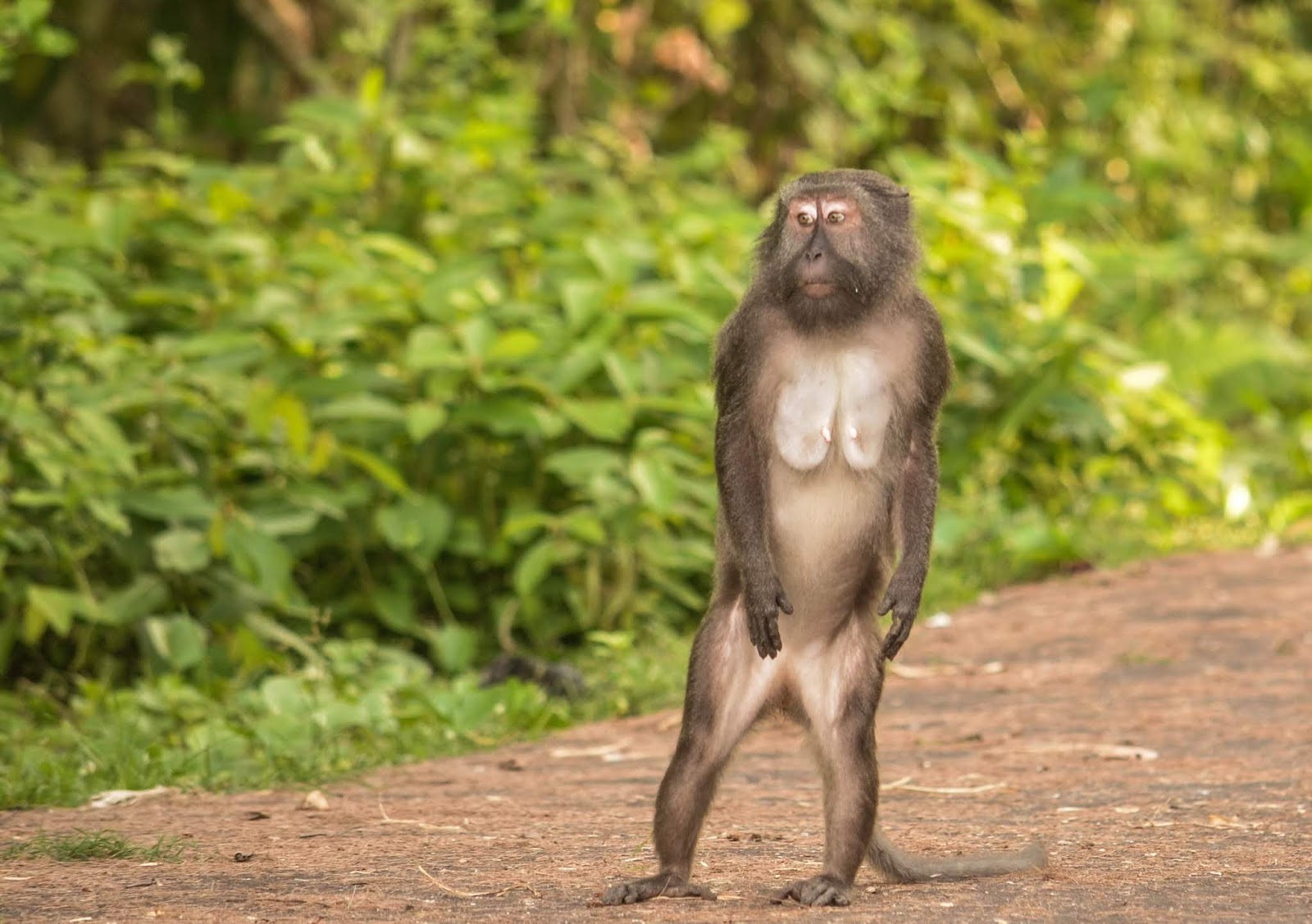
These monkeys have faces that seem astonishingly readable at first glance. Unlike some of the other macaque species, they have long hair on their faces, but none around their eyes. Their eyelids are several shades lighter than the rest of their skin and body, and they stand out distinctly under their thick, bushy eyebrows. Their eyes tend to be a caramel brown – piercing when directed at you. When I first began following them, I was the one being observed. It took a month of respectful distance and nonchalance on my part for the troop to relax in my presence. During this period of habituation, I began to notice personalities and tendencies of several individuals and discover their responses to my body language. I took notice of them taking notice of other passers-by, but not of me. I realized at this point that they either trusted or tolerated me, and I was keen to know which one it was.

Initially, I found that I couldn’t sit down during the day. Every time I did, I suddenly became accessible; a curio that the larger males and enthusiastic sub-adults would make a beeline for, probably hoping to raid me for some food. They’d be abruptly aware of me, as though I appeared out of nowhere, and this bothered some of the more timid and cautious individuals in the group. Just as you’d find in a social gathering of people, within the troop, some monkeys take longer to warm up to you than the others, some are ever-suspicious, some are eager and inquisitive, and some simply don’t care. Soon, I found that majority of the troop fell into the last category. Having moved from an unwanted intruder that prompted an angry chorus of alarm calls through the forest patches to one of unexciting, repetitive and uninteresting demeanour, it felt like an achievement. Never before had I been as happy to be the one not worth noticing.

This being said, I’ve come to share some tickling moments in close proximity with those whose lack of concern for me led them to attempt interaction. On one such day, I sat down in the grass, tired from having walked after them for nearly eight hours. I put my clipboard in my bag and watched the monkeys groom themselves lazily in the cloudy afternoon haze. I suddenly felt one of the monkeys grip my shoulder. It was Tripod, one of the more dominant males of the group. Having made contact with me uneventfully, three other sub-adult males, a female and another adult male made their way up to me. From their casual strides and relaxed eyebrows, I felt rather confident that they meant no harm. They seated themselves around me; a couple leaned against me and began to doze off. My heart was thumping against my chest and I could feel the pulse in my neck – I was elated. Just then, their little hands began touching my arms and legs. They lifted my shirt sleeves to inspect underneath. They began to pick ants off of my pants and pop them into their mouth. Tara, another male, used his teeth ever so gently to pull off some scabs on my arm. I was being groomed. This lasted no longer than five minutes, before a female some feet away seemed to disapprove of the gathering. She raised her eyebrows rapidly, sounding low alarm calls while shooting glances at several individuals around me. I rose and stood back slowly, and the female went back to grooming her infant, as though the whole thing never happened.

On another day, I was standing fairly close to the troop while noting down some data, when a huge fight broke out among the monkeys. Nearly every adult ran frantically to the centre of conflict and the air filled with their calls of skirmish. I was left standing amidst those who opted out, now some distance away from most of the troop. As the ruckus died down, the adults slowly sauntered back to where I was. There was palpable tension in the air that I couldn’t shake; it seemed like they couldn’t either. Several monkeys searched me with their eyes as they passed by, something that was rather unusual. A couple of them sent rapid signals to the others, and several began grunting at me. The males pulled themselves up to their full, impressive height and advanced towards me in an unamicable fashion. A couple yanked at my pants and bared their teeth. Once more, I silently backed away, and they settled down almost instantly.

I realize now that even if what they have toward me is tolerance, they trust me to understand their signals. In both the occasions I related (and some more which I didn’t), the monkeys could have easily torn me to shreds with their remarkable canines and hardy nails; they have with others in the past. They could have chased me far away from where they rested; again, they have with others in the past. Instead, they chose to provide me with a minimalistic warning and let me off easy. Maybe they were okay with having a human amidst them who hadn’t tried to harm them thus far, unlike nearly every other person they encounter each day. Whatever the reason, these events help me stay grounded and remember never to take their acceptance for granted. I have utmost awe and respect for these animals, no matter how amusing, strange and quirky they can be at times.

These fantastic, wild creatures are complicated. They have moods, personalities and emotions; and I don’t feel presumptuous for saying it anymore. Watching them day in and day out for these past few months only convinces me of this further. Perhaps the data I collect will fail to portray this, with only numbers telling tales of their behaviour, but the experiences I’ve had with them will remain more fascinating and dear to me than can be statistically discernible.

Thursday, June 15, 2017

Ladakh and the Andaman Islands

(All photos and/or videos to be added at a later date once stronger internet connection is obtained.)


Since 2013, I’ve been fortunate enough to have worked in and/or visited several places; twelve, to be exact. Of all these wonderful places in India, two have stood out with auras of emotional flamboyance – Ladakh and the Andaman Islands. Lately I’ve been wondering what it is about two places so completely different in their position, biodiversity and climate, that captured my attention so adhesively, and have come to realize they have more in common than what meets the eye.

ONE: Getting there can be challenging, yet beautiful.
Three things can come in the way of traveling to both Ladakh and the Andamans. (1) Weather – snow or rain, (2) prices – being spontaneous burns a deep, deep hole in your pocket, and (3) their exotic reputation – a sense of it being an unusual place to simply go to. But once you get there, good lord, it tugs at your breath better than Rowling’s dementors. Whether it’s the vast expanses of the Himalayas that throw the skies and land open as far as the eye can see, or the dense forests of the islands that filter sunlight and rain several-fold before they reach you, they’ll force you to stop and absorb them.

TWO: It’s expensive to get there, but cheap to live there.
Which is why I’ve devoted large amounts of my thinking time to figuring out ways in which to get there and never leave. Renting a small flat in Ladakh is a fourth of the price (if not lower) than that of an equivalent space in Mumbai. In the Andamans, it’s about a third. Either way, it makes up for the cost of getting there, and in return you get the serenity of nature with enough amenities to get you by over long periods of time. It’s perfect.

THREE: Developed, but not entirely.
Both places have a central, developed town/city which has restaurants and some hotels for tourists, small food shacks which are frequented by the locals and a bunch of general stores. Ladakh has its quintessential marketplace in Leh where anyone can buy woolens and household items, eat at a handful of restaurants or buy souvenirs from handicraft emporiums. The markets in the Andamans that compare are in and around Port Blair, but they are certainly more city-like than the quaint shops that line the streets of Leh. Sanitation, electricity and internet are available across both areas, though they are never entirely reliable. As Calvin’s Dad would say, these kinks in the global definition of ‘development’ build character and add to one’s learning of the places’ cultures and strife. I’ve learned more about life and work from my time in these places than I have living in Mumbai, and I’ve come to treasure those bits of me.

FOUR: Land-locked, sea-locked, remote and isolate.
The Himalayas that fall in Ladakh rise tall around the modest strip of runway at the Leh airport. Flying into Leh is gorgeousness, for it feels like gliding over a giant raster of geographic elevation, occasionally obstructed by blindingly-white clouds. The skies are always a limpid blue and the mountains are continuous and unrelenting. Layer after layer of peaks make you wonder where you’d ever land and about all the animals you’re flying over. When the little buildings and fields emerge from the landmass, they seem desolate and, in personification, content. Flying to the Andamans gives you the same feeling of gaping vastness and detachment from familiarity. The ocean is the same bright blue of the Ladakh sky and the coastlines gleam with their slivers of sand. Every island is a cluster of bright green vegetation – something I hope will hold true even years into the future. Both places are distant – in time if not in kilometres.

FIVE: Un-capturable landscapes.
You cannot photograph the Himalayas or the Andaman seas and forests without losing their overwhelming presence. No photo can capture the way these landscapes envelope you and stretch far out to the horizon. A photograph is 2D, but what you see with the naked eye is beyond 3-dimensional. It’s several added dimensions of wonder, intimidation, smells and sounds, which are completely lost once your shutter goes off. That being said, one can never take a bad photo of the mountains or sea. It’s a limbo of oomph, but a compromised oomph.

SIX: Tourists, people, and their animals.
Both these places are tourist hotspots and function seasonally, given their unfavourable summers and monsoons. If you go to Ladakh between December and June or the Andamans between September and March, you’re bound to meet a range of tourists – from loud joint families to solitary observers. The descendence of these tourists have come to dictate the lives of the locals, and now, their livelihoods rotate around these months. You'll find a clear distinction between the locals and anyone else who attempts to integrate. The people of the land are a humble, helpful and self-assured kind, dotted with colourful and unforgettable personalities. From caring for up to fifty domestic animals per household to dealing with feral dogs and animals, being a local comes with its share of challenges. I refrain from calling the people from these places simple, for that’s an unfair label to give them. Even though they don’t live in metropolitan cities or drive swanky cars, they lead complicated lives which are often harder than we realize. Visiting and living with them have taught me a great deal, and I’ve come to criticize and value various aspects of my life ever since.

SEVEN: The elusiveness of their wildlife.
The Himalayas are known for their large mammals, however, the snow leopard isn’t its only ‘ghost of the mountains’. It’s a landscape full of camouflaged wildlife that isn’t easy to track or spot. The Andamans house far fewer mammals, but is teeming with bird life which isn’t the easiest to find amidst its dense trees and vines. In both places, the wildlife teases you, with calls and signs, poop and tracks, but rarely graces you with its presence. If one of these wonderful creatures does show itself, live the moment. Don’t fumble for cameras or tripods or lenses, for that moment won’t last. Simply absorb it, etch it in your mind, make it a memory that you’ll hold onto forever.

EIGHT: No matter where you are, a picturesque landscape is never more than 15 minutes away.
This is a virtue of point THREE above. Perhaps this will change with time, as the Border Road Organization hacks away at the mountains or as deforestation progresses in the islands. But until those sad times befall us, these landscapes are always nearby, waiting to be gawked at.

NINE: There’s more to be known about them than is known already.
Ladakh and the islands are rich in ecological and social history. There are traditions and biodiversity that are yet to be explored and scrutinized. As time passes, more and more researchers seem to be showing interest in these scientifically uncharted fields, and rightfully so. Both places pique my curiosity more than places like the Western Ghats simply because there’s so much we’re yet to learn about them.

TEN: Disconnection from the rest of the world.
Finally, these places give you the option of unplugging every electronic device and living in the present. Disconnection from the world isn’t necessarily a direct result of poor internet or telephone towers. These places tend to make you cherish the option of switching off and using your phone and email only for the essential few communications. You can rely on newspapers for news and wave goodbye to social networking. And the best part is that you don’t miss it. Even slightly (disclaimer: this could be only my perspective). I maintain that the less my friends and family hear from me, the fewer pictures I have and the more notebooks I fill, the more fun I’m having.

I hope fervently that things stay this way even in the years to come, however romantic or idealistic that hope may be.